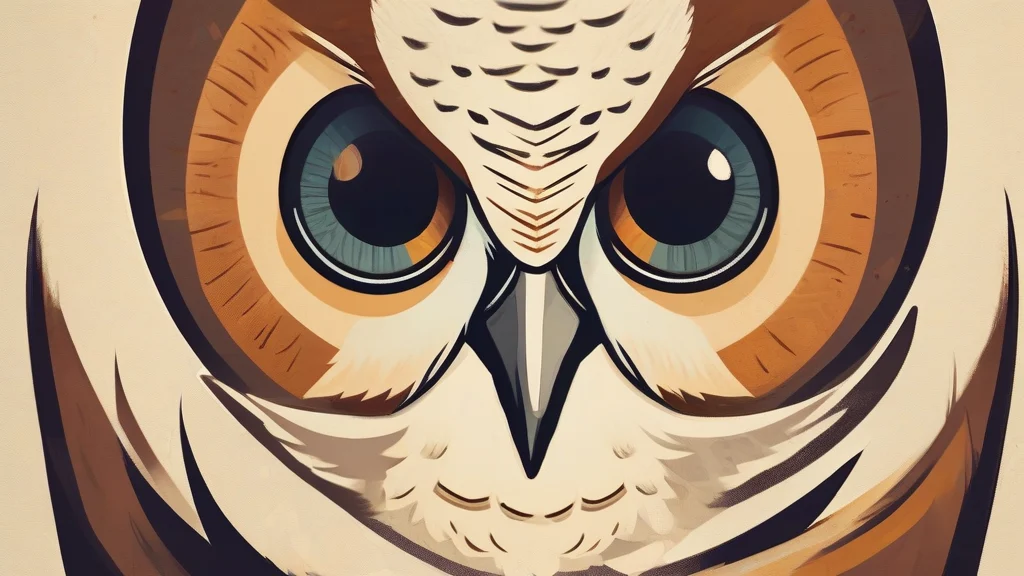
What does owlish mean?
The adjective 'owlish' describes a person or expression that conveys wisdom, thoughtfulness, and intelligence, often reminiscent of an owl's perceptive gaze. Typically used to characterize someone with a studious or introspective appearance, often enhanced by glasses or a contemplative demeanor. This term is not meant to be derogatory but rather to highlight a person's insightful or discerning nature. 'Owlish' can be applied in various contexts, from describing a professor's wise look to a child's unexpectedly mature expression. The term is commonly used in British and US English, adding a touch of literary flair to descriptions of people and their appearances.
adjectiveHaving or resembling the wise and thoughtful expression of an owl.
- Having a wise and thoughtful expression.
- Resembling an owl in appearance or demeanor.
"She looked owlish behind her glasses, as if perpetually surprised."
"The owlish professor peered over the rim of his spectacles."
"The child's owlish face made her seem older than her years."
Reviewed by Deb Chak, Editor. AI-assisted content curated by RJS Tech Solutions LLP.
Etymology of owlish
The term 'owlish' originates from the association of owls with wisdom and insight in various cultures. The word 'owl' itself has Old English roots, related to the Proto-Germanic '*uwwal-' and Proto-Indo-European '*huh-', imitative of the owl's hoot. The suffix '-ish' is used to form adjectives indicating a resemblance or characteristic. Thus, 'owlish' literally means 'resembling an owl' or 'having the qualities of an owl,' specifically its wise and thoughtful nature.
How owlish is actually used
Often used to describe someone with glasses or a bookish appearance.