
What does pan mean?
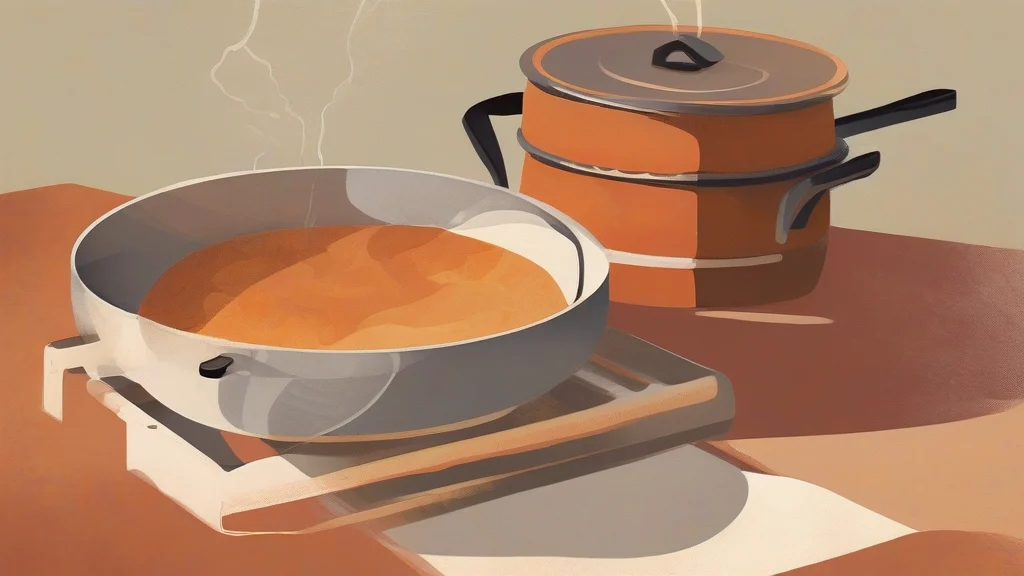
Pan is most familiar as a noun for a shallow cooking vessel, especially the frying pan or saucepan used to heat oil, sauté food, or boil small amounts of liquid. In that sense, it is an ordinary household word with both British and American usage. Pan also works as a verb meaning to criticize a film, book, performance, or idea harshly, a use that is informal but well established in reviews and conversation. Modern media language adds the verb’s camera sense: a camera operator pans across a scene to follow movement or reveal a wider view. Less common noun senses include the shallow gold-washing dish called a gold pan and the informal word for a person's face. The verb phrase “pan out” means to develop or turn out in a particular way. Altogether, pan is a compact and versatile word whose culinary and critical senses are both immediately recognizable.
A shallow cooking vessel, usually made of metal and fitted with a handle; in mining, also a shallow dish used for separating sediment or gold.
"He lifted the lid from the pan and checked the sauce."
The basic cooking sense is standard in British and American English. The gold-panning sense is specialized, while the informal sense meaning “face” is regional and less formal.
To criticize something harshly, or to move a camera smoothly across a scene or subject.
"Critics panned the adaptation for ignoring the original novel."
The critical sense is informal but common in reviews. The camera sense is standard in film, television, and photography.
The standard plural is pans. The word is also commonly used in the fixed expression “a pan of” for a quantity of food or liquid.
"She brought out two pans of lasagna for dinner."
From the kitchen vessel that cooks food to the critic's sweeping judgment, one small word carries both a recipe and a verdict.
Reviewed by Deb Chak, Editor. AI-assisted content curated by RJS Tech Solutions LLP.
Where does pan come from?
The cooking-vessel noun developed through Middle English panne or pan from Old French panne, ultimately from Latin panna, meaning a shallow dish or pan. Related forms include pancake, while panna preserves a cognate form from the same Latin word. The critical verb is a later figurative development associated with the idea of examining or raking through a subject, and the camera sense is a modern extension of the idea of sweeping across a field of view.
Related word forms
How pan is actually used
The verb meaning “to criticize harshly” is informal and especially common in reviews and criticism. The camera sense is standard in film, television, and photography. In British and Irish informal speech, pan can also mean a person's face.
Easily confused with pan
A pan is a cooking or other shallow vessel, whereas a pane is a sheet of glass, as in a window.