
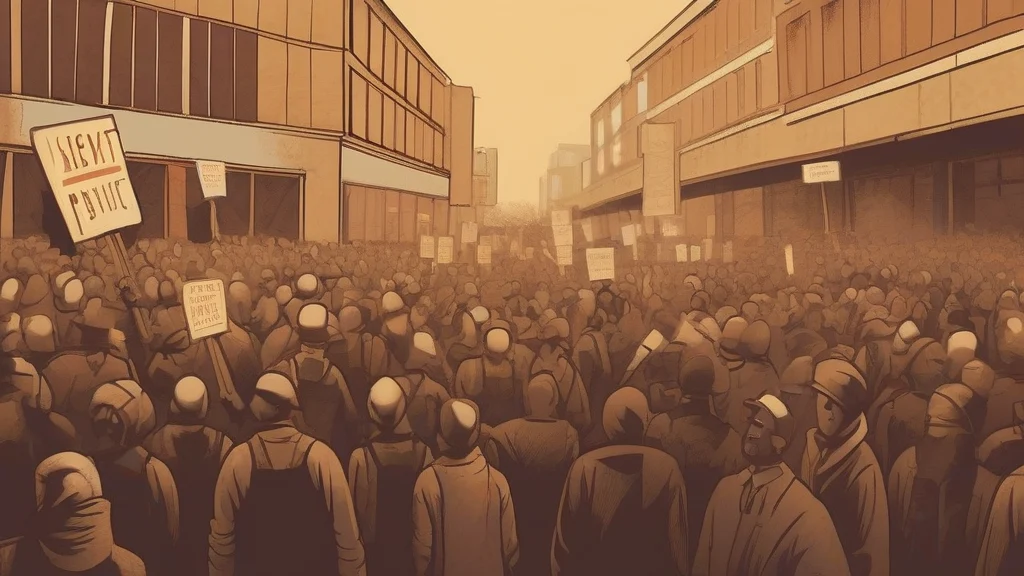
What does picketing mean?
Picketing is a form of public protest in which workers or other demonstrators gather at a workplace or institution to publicize a dispute and may discourage people from entering or working there. As a noun, it can denote either the collective action or the group of people maintaining a protest line; as a verb, it means to take part in or organize such action. Picketing is especially associated with labor disputes, although it is also used in political and community protests. The related phrase "picket line" refers to the line of demonstrators protecting or marking a workplace entrance. Although the activity is peaceful in its modern sense, its history includes coercive forms in which people were prevented from working. Today, the term remains a standard term in labor relations and carries a generally neutral, institutional connotation.
A protest in which people gather at a workplace or other establishment to draw attention to a dispute, or the group of people participating in such an action.
"The picketing outside the depot continued for three days."
The noun is commonly used as an uncountable name for the action; "pickets" is the usual plural for the individual protesters.
To take part in a protest at a workplace or other establishment, especially by forming or maintaining a picket line.
"Employees picketed the factory to protest unsafe working conditions."
This verb usually implies organized collective protest rather than an individual demonstration.
The action is normally treated as an uncountable noun. When referring to the people themselves, the standard plural is "pickets."
"The picketing continued outside the factory throughout the afternoon."
The word once described a pointed stake; it later became a boundary of people—and eventually the modern protest action that bears the same name.
Reviewed by Deb Chak, Editor. AI-assisted content curated by RJS Tech Solutions LLP.
Etymology of picketing
The word comes from English "picket," originally a pointed stake or peg, which was borrowed from French "piquet." The French word was derived from "piquer," meaning "to pierce," ultimately connected with "pic," meaning "pitch." The military sense of a guarded post developed before the modern labor sense of picketing emerged in the nineteenth century. Cognates such as English "pique" and "piquant" preserve the same French verbal root.
Related word forms
How picketing is actually used
The term is used in British and American English, especially in labor relations but also for protests outside shops, schools, and other institutions. It can refer either to the protest itself or to the people forming a picket line. "Picket line" is more specific than the general word "protest line."