
What does pumpkin mean?
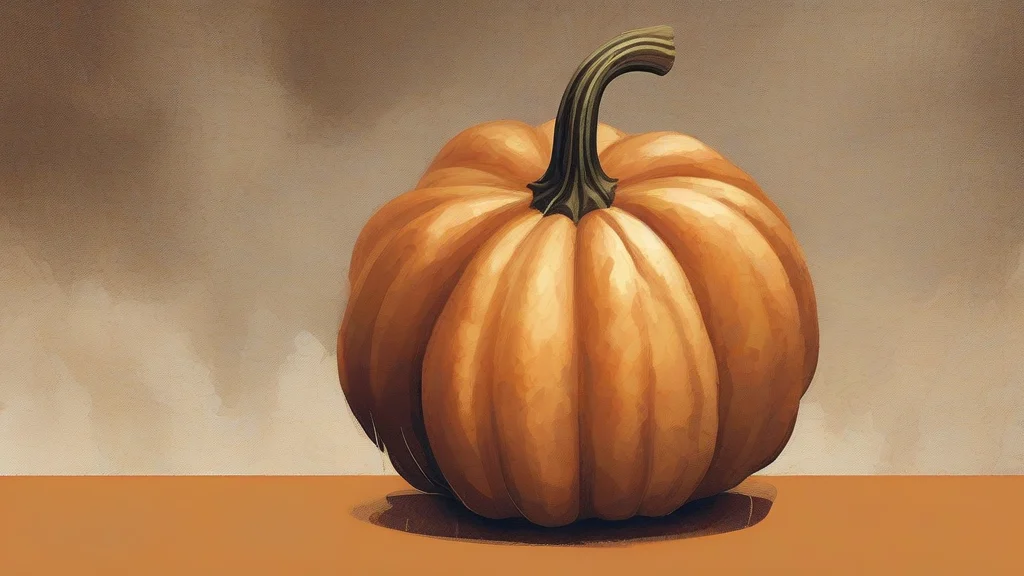
Pumpkin most often denotes a large fruit with a firm rind and numerous seeds, especially the orange varieties associated with autumn, Thanksgiving, and Halloween. It is botanically a member of the gourd family and is closely related to other winter squashes. The word can also refer to the plant that produces the fruit. In informal British and Irish English, pumpkin may mean a person's head, with the tone shifting from playful affection to mockery depending on how it is used. As a food, pumpkin is commonly prepared in pies, soups, breads, and savory dishes, while its seeds are often roasted as a snack. Its distinctive seasonal associations have made it an enduring symbol of harvest, abundance, and Halloween. Although the familiar orange pumpkin is cultivated in many countries, related pale, green, and deeply ridged varieties also exist, showing that the word covers a diverse group of fruits rather than a single uniform variety.
nounA large, usually round fruit with a hard orange-yellow rind and many seeds, eaten as a vegetable and commonly associated with autumn and Halloween. The word can also denote the plant that produces this fruit and, informally, a person's head.
- The edible fruit of a pumpkin plant, especially the large orange or yellow varieties commonly used in cooking and carving.
- The herbaceous plant that produces pumpkins and belongs to the gourd family.
- Informally, a person's head.
"She carved a smiling jack-o'-lantern from the pumpkin on the porch."
"We roasted the pumpkin and served it with sage and brown butter."
"The old farmer knew that every plant in the field would eventually produce a pumpkin."
The plural is regular and takes the ending -s; the final -n is retained.
"The market was filled with pumpkins of many shapes and sizes."
Botanically, a jack-o'-lantern is a fruit: pumpkins grow from flowers and carry their seeds inside.
Reviewed by Deb Chak, Editor. AI-assisted content curated by RJS Tech Solutions LLP.
Where does pumpkin come from?
The English word dates to the early modern period and developed through an alteration of the obsolete form pummon, which was borrowed from French pompon. French pompon came from Medieval Latin pepon, an accusative form of the Latin pepo meaning a melon or gourd, ultimately from Greek pepon. Early modern English also used spellings such as pumkin and pompion before the modern form pumpkin became established.
Related word forms
How pumpkin is actually used
The fruit and plant senses are standard in British and American English. The informal sense meaning a person's head is mainly associated with British and Irish English and may sound teasing, affectionate, or insulting depending on context.
Easily confused with pumpkin
Pumpkin is a particular kind of squash, generally classified as a winter squash, while squash names a broader group of fruits including pumpkins, butternut squash, and acorn squash.