
What does rigatoni mean?
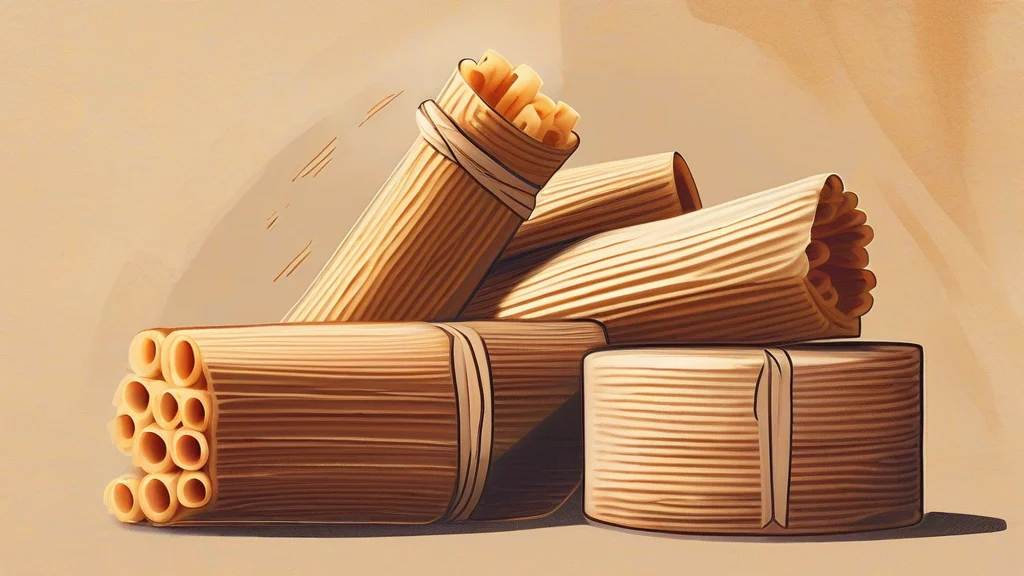
Rigatoni is a popular pasta made from short, hollow tubes with ridges running along their surfaces. The tubes are commonly straight-cut, although some varieties have slightly angled edges. Their textured exterior helps sauces and melted cheese cling to the pasta, making rigatoni especially common in baked dishes and preparations with chunky sauces. The word is used in both everyday cooking and restaurant contexts, often in association with Italian-American cuisine, although it is also a standard pasta shape in Italy. In English, rigatoni is normally treated as an invariant plural or mass noun: one speaks of “a piece of rigatoni” rather than normally using a singular form. Its name comes from Italian and refers to the pasta’s ridged or fluted shape. Rigatoni is related in appearance to smooth tubular pasta such as ziti and slanted varieties such as penne, but the characteristic ridges distinguish it. It is a useful word for anyone discussing pasta shapes, baked pasta, or the way texture affects how a dish serves and tastes.
nounA type of pasta consisting of short, hollow tubes with ridged or fluted surfaces, usually cut straight across at each end.
- A tube-shaped pasta with ridged surfaces, especially when used in Italian or Italian-American dishes.
"We ordered baked rigatoni with marinara sauce and melted mozzarella."
"The rigatoni was coated in a rich tomato and basil sauce."
"For dinner, she baked a casserole of rigatoni with three kinds of cheese."
The form is normally invariant in English and functions as a plural or mass noun; the singular “rigato” is not ordinarily used.
"They bought two boxes of rigatoni for the party."
Rigatoni means “ridged ones,” and those ridges help the pasta hold onto its sauce.
Reviewed by Deb Chak, Editor. AI-assisted content curated by RJS Tech Solutions LLP.
Where does rigatoni come from?
Rigatoni comes from Italian, where it is the plural of rigato, meaning “ridged” or “fluted.” Rigato was formed from rigare, “to flute” or “make ridges,” a development connected with Latin rigare, with related forms including Italian riga, “line” or “stripe,” and rigatelle, another ridged pasta. The English culinary word preserves the Italian form and normally functions as an invariant plural.
How rigatoni is actually used
The term is culinary and generally neutral. In English, it is normally treated as an invariant plural or mass noun, so the singular form is rarely used.
Easily confused with rigatoni
Rigatoni has pronounced ridges along its surface, whereas ziti is smooth and hollow.
Rigatoni is generally cut straight across, while penne traditionally has angled or slanted ends.