
What does sagebrush mean?
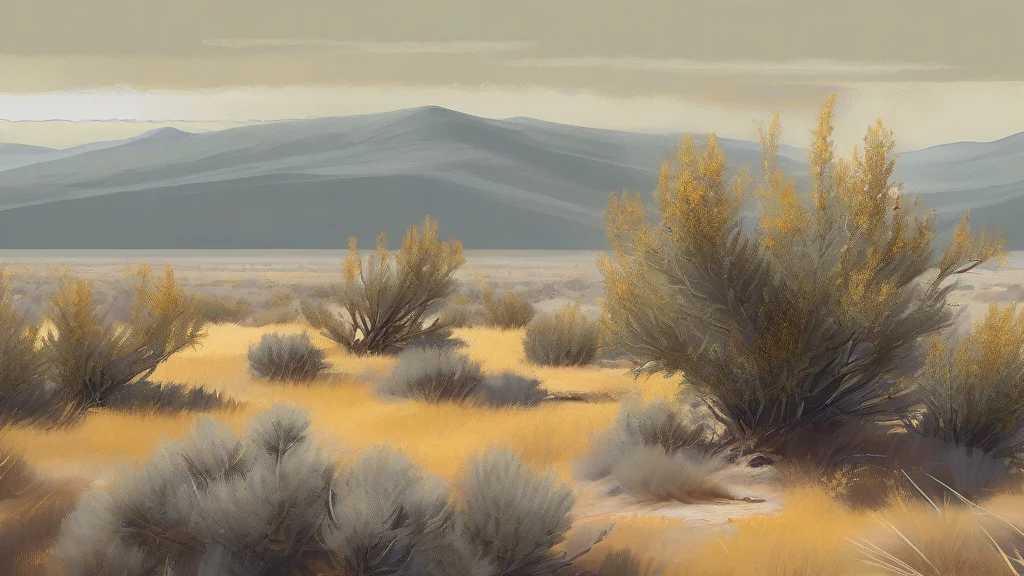
Sagebrush names a tough, aromatic shrub native to the dry valleys, plains, and foothills of western North America. Its common botanical referent is Artemisia tridentata, a woody member of the daisy family whose pale gray-green leaves and small flowers help it tolerate heat, drought, wind, and alkaline soils. In broader usage, sagebrush can describe either a single plant or a landscape dominated by dense stands of these shrubs. The word is especially associated with the sagebrush steppe and semiarid regions of the Great Basin, where it provides food and shelter for animals such as mule deer and sage grouse. It is also familiar from the history and mythology of the American West, including theSagebrush School and the broader cultural image of ranching and open desert country. Although related in name to culinary sage, sagebrush is botanically distinct and should not be treated as an ordinary garden sage.
An aromatic, gray-green woody shrub of the daisy family, especially Artemisia tridentata, native to the semiarid regions of western North America.
"Sagebrush covered the ridge in a dense silver-gray stand."
The plural sagebrushes is used for individual shrubs, but sagebrush is also commonly treated as an uncountable mass noun for the vegetation collectively.
A stretch of country or vegetation dominated by sagebrush.
"They crossed miles of open sagebrush before reaching the river."
This collective use is particularly associated with the landscapes of the western United States.
Use sagebrushes when referring to individual shrubs; use sagebrush as a mass noun when referring to the plant or vegetation collectively.
"Several sagebrushes stood beside the trail."
Sagebrush landscapes inspired some of the best-known imagery of the American West, yet the plant itself is a hardy survivor of heat, drought, and poor soil.
Reviewed by Deb Chak, Editor. AI-assisted content curated by RJS Tech Solutions LLP.
Where does sagebrush come from?
Sagebrush is a compound formed in the 19th century from sage and brush. Sage had already acquired the name of the aromatic plant in English, while brush referred to a shrub or a dense tangle of vegetation; the compound originally denoted a particular bushy plant and later came to characterize the arid country in which it grows. The same sense is reflected in place names and regional terms such as Sagebrush Country, which evokes the sagebrush landscapes of the American West.
Related word forms
How sagebrush is actually used
Sagebrush is most common in the western United States, particularly in the Great Basin and Rocky Mountain regions. It is normally used as a mass noun for the vegetation and as a countable noun for an individual shrub.
Easily confused with sagebrush
Sage can refer to several aromatic herbs in the mint family, while sagebrush denotes a distinct woody shrub in the daisy family.