
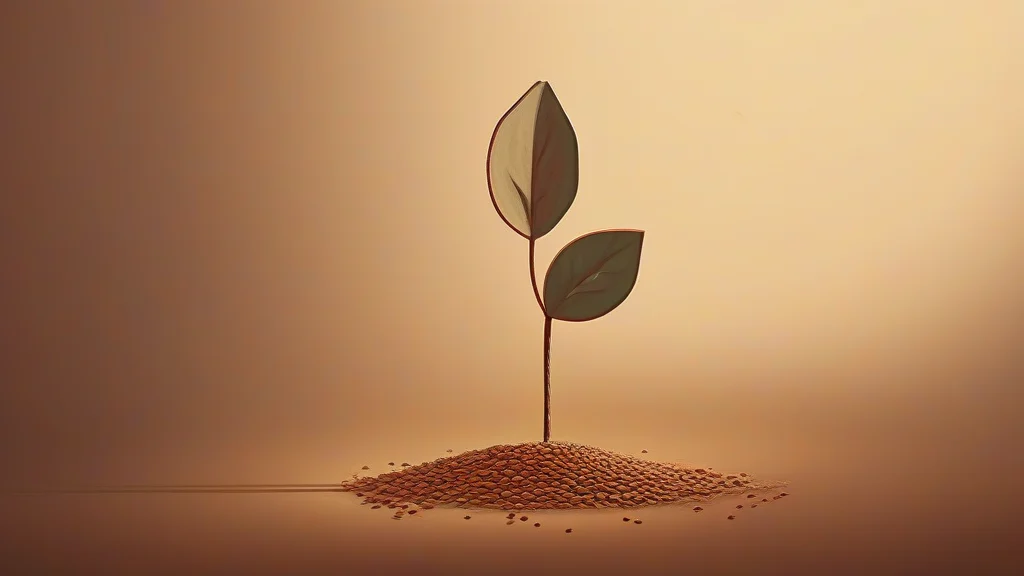
What does seed mean?
A seed is the small, often hard or edible part of a flowering plant that can grow into a new plant. The word also commonly refers to the beginning, source, or potential from which a larger development can arise: a promising idea may be described as a seed, and an early investment as seed capital. In sports, to seed someone or something means to place them in an advantageous position in a ranking or draw. As a verb, seed means to plant seeds, but it can also mean to introduce, populate, or establish something. The word is familiar in gardening, agriculture, cooking, finance, biology, and everyday figurative speech. Its basic image is a compact beginning containing the potential for substantial future growth.
A flowering plant's seed, especially the part capable of growing into a new plant; also, by extension, a source or beginning with latent potential.
"The seed sprouted after several days of rain."
In figurative use, 'seed' often denotes an initial idea, resource, or opportunity that may develop into something larger.
To plant or scatter seeds; to introduce, populate, or establish something, or to place someone or something in an advantageous position.
"They seeded the field with native grasses and wildflowers."
The verb is also used in informal or sporting contexts when describing the initial ranking or arrangement of competitors.
The plural 'seeds' is used for individual plant seeds, seeds used as food, and figurative beginnings or sources.
"The birds scattered seeds across the garden."
Every forest begins with a tiny package of possibility: a seed.
Reviewed by Deb Chak, Editor. AI-assisted content curated by RJS Tech Solutions LLP.
Where does seed come from?
The English word descends from Old English sæd, used for a plant seed, and ultimately from a Germanic root associated with sowing. The related English verb 'sow' comes from the same broad etymological tradition, reflecting the close connection between seeds and the act of planting them. The precise prehistoric development of the Germanic forms is not entirely certain.
Related word forms
How seed is actually used
As a noun, 'seed' is common in botanical, agricultural, and figurative contexts. As a verb, it can mean planting seeds, introducing people or animals into an area, or placing someone or something in a favorable competitive position.
Easily confused with seed
A seed is the reproductive unit of a plant, while to sow means to plant or scatter seeds.