
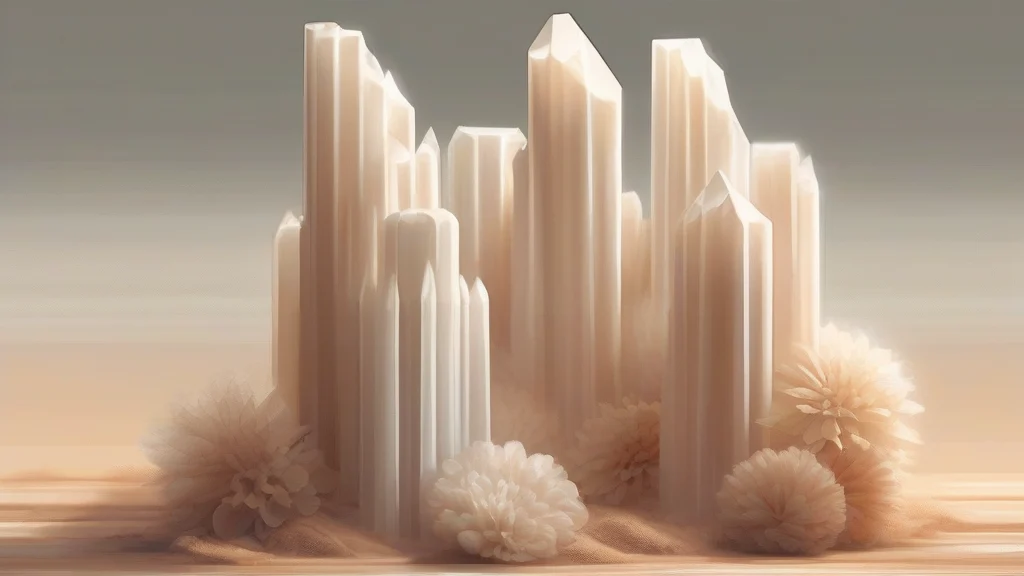
What does selenite mean?
Selenite is a transparent, crystalline variety of gypsum, a soft sulfate mineral that occurs in many sedimentary and evaporite deposits. Its clear or translucent crystals and reflective cleavage surfaces have long made it useful for carving vessels, figures, beads, lamps, and ornamental architectural pieces. In specialist usage, the word can also refer to moonstone or to gypsum varieties distinguished by their lunar or silvery appearance. The term comes through scientific mineralogy from Greek selēnē, meaning “moon,” with the suffix -ite, a convention used for minerals and related substances. Although selenite is prized for its delicate appearance, gypsum’s relative softness means that finished objects can be scratched or damaged easily. In a dictionary entry, selenite is therefore best understood as both a precise mineral variety and a traditional name linked to the Moon’s pale, luminous appearance.
nounA transparent, crystalline variety of gypsum, commonly used for ornamental objects, sculpture, and decorative stone. The term is also sometimes used for moonstone and other gypsum forms associated with a silvery or lunar appearance.
- A transparent, crystalline variety of gypsum, often valued for carving and ornament.
"The museum displayed a bowl carved from selenite under soft gallery lighting."
"She polished the selenite until its surface shimmered like water."
"Geologists identified the pale band in the cliff as selenite."
Usually used when referring to individual mineral specimens or multiple pieces of the mineral.
"The collection includes several selenites from the region."
The name selenite comes from the same Greek root for the Moon that gives selenium its name, linking this luminous crystal with our celestial companion.
Reviewed by Deb Chak, Editor. AI-assisted content curated by RJS Tech Solutions LLP.
Where does selenite come from?
The word selenite was formed in English from Greek selēnē, meaning “moon,” combined with the mineral-forming suffix -ite. Its name reflects the mineral’s silvery or moonlike appearance and follows the convention of naming many minerals with -ite. The same Greek root also underlies selenium, selenography, and selenology, all of which refer respectively to the element selenium, the mapping of the Moon, and the scientific study of the Moon.
Related word forms
How selenite is actually used
The word is mainly used in geology, mineralogy, lapidary, and decorative-art contexts. In some specialist and historical contexts, it can refer more broadly to moonstone or other gypsum varieties, so its meaning depends partly on the field and context.
Easily confused with selenite
Selenite is a mineral variety of gypsum, whereas selenium is the chemical element with the symbol Se.