
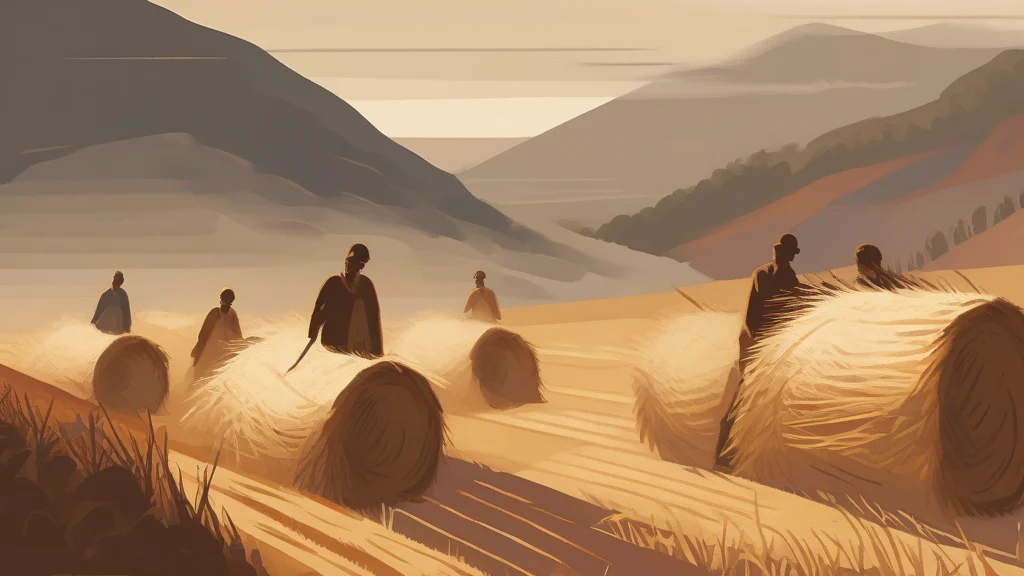
What does sheaving mean?
Sheaving is the process of gathering harvested grain or other cut crops into bundles called sheaves. As a noun, it names that work; as a verb, it describes the action itself, as in “sheaving the wheat.” The term belongs mainly to agricultural and literary language and sounds old-fashioned to many modern speakers, although the underlying verb remains clear. Historically, farm workers bound stalks into bundles by hand before they could be gathered, transported, and threshed. Sheaving could therefore describe both the manual skill of making a sheaf and the broader seasonal task of harvesting. In contemporary discussion, the word is more likely to appear in novels, poems, historical writing, or descriptions of traditional farming than in everyday conversation. Its survival in such contexts preserves a vivid picture of rural labor and the stages by which grain once moved from field to store.
The action or process of gathering harvested grain or other crops into bundles called sheaves.
"The sheaving of the grain continued until evening."
Usually treated as an uncountable process noun; the plural sheavings is possible but uncommon.
To gather harvested grain or other cut crops into bundles called sheaves.
"They spent the afternoon sheaving the barley."
The present participle of sheave, now chiefly found in literary, historical, and agricultural contexts.
The plural is uncommon; sheaving is usually treated as an uncountable process.
"The workers completed several sheavings before the storm arrived."
Before modern combines, much of the grain was still bound by hand into sheaves—a harvest scene remembered vividly in literature.
Reviewed by Deb Chak, Editor. AI-assisted content curated by RJS Tech Solutions LLP.
Where does sheaving come from?
Sheaving is an English formation from the verb sheave with the suffix -ing. The verb belongs to the same Germanic family as sheaf, which descends from Old English scefe; related forms include Dutch schoof and German Schof. These words share an older Germanic tradition of referring to a bundle or sheaf of harvested stalks.
Related word forms
How sheaving is actually used
Chiefly literary, historical, or archaic in modern English. It remains transparent as the gerund of the verb sheave and is more common in descriptions of traditional farming than in everyday speech.
Easily confused with sheaving
To sheave is to bind material into sheaves, whereas a sheave is the resulting bundle; a sheave can also mean a grooved pulley wheel.