
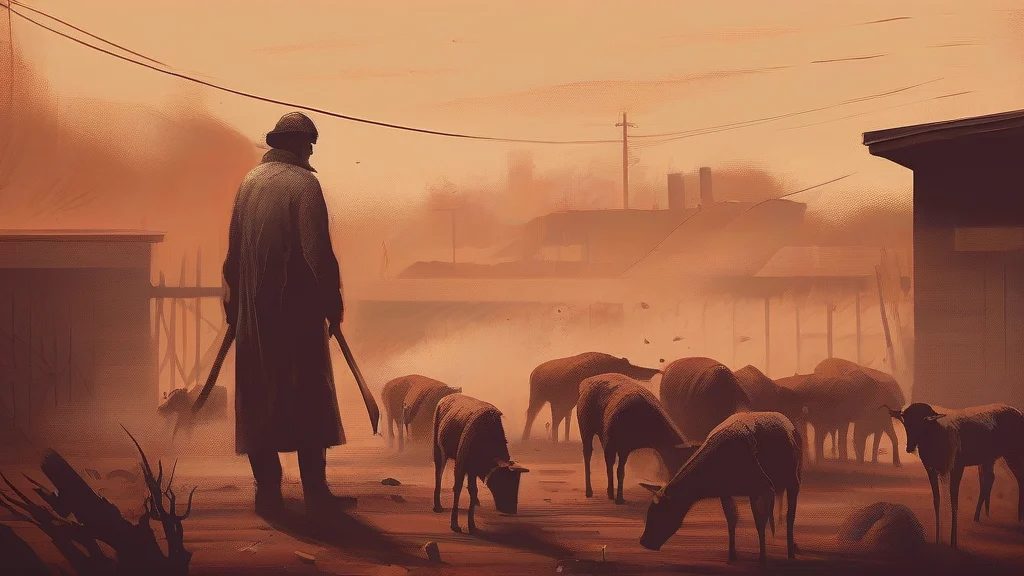
What does slaughtering mean?
Slaughtering is the present-participle and gerund form of slaughter. Its central meaning is the killing of animals, especially for food, as in the processing of livestock. It also has a much more serious sense: the violent or indiscriminate killing of people, often used in reporting war, atrocity, or mass killing. In that sense, the word is strongly negative and can suggest brutality, although it may simply identify an action in legal, historical, or news contexts. Figuratively, “slaughtering” can describe overwhelming an opponent, often in sport or competition. The verb form requires a subject—“the farm was slaughtering cattle”—while the gerund can function as a noun: “the slaughtering of civilians was condemned.” As an attributive modifier, “slaughtering industry” normally refers specifically to animal processing. The term is powerful because the same literal process can be routine in one setting and horrifying in another, so context largely determines whether it sounds practical, journalistic, or accusatory.
As a verb, slaughtering is the present participle of slaughter: killing animals for food or violently and indiscriminately killing people. Figuratively, it can mean defeating an opponent decisively.
"The abattoir was slaughtering cattle throughout the morning."
The phrase “slaughtering animals” is often neutral in an agricultural or food-processing context; the same form applied to people is intensely negative.
As a gerund noun, slaughtering denotes the act of killing animals for food or the act of violently and indiscriminately killing people.
"The international community condemned the slaughtering of civilians."
It is usually treated as a mass noun; the plural “slaughterings” is possible but uncommon.
As an attributive modifier, slaughtering describes an industry, organization, group, or process involved in killing animals or people.
"Inspectors visited the slaughtering plant to verify its compliance with animal-welfare rules."
This use most often refers to the animal-processing industry; a figurative attributive use can describe overwhelming success in competition.
The plural is grammatical but uncommon; “slaughtering” is normally used as an uncountable gerund noun.
"The early reports described the slaughterings at several locations."
The same word can describe a farm's daily work or a battlefield's deadliest act—a grim testament to how context can turn routine work into an accusation of horror.
Reviewed by Deb Chak, Editor. AI-assisted content curated by RJS Tech Solutions LLP.
Where does slaughtering come from?
Slaughtering is formed by adding present-participle and gerund endings to slaughter. Slaughter appears in Middle English as slahter, continuing Old English slæht, meaning “slaughter” or “death by violence,” with close cognates in Old Norse slátr and Old High German slahta. These forms are generally traced to a Germanic root associated with striking or slaying, reflecting the word's long history across both animal butchering and violent killing.
How slaughtering is actually used
The term is neutral or technical when referring to the killing of livestock for food, but it carries strong connotations of brutality, violence, or indiscriminate death when applied to people. Figurative use, especially in sport and competition, is informal and means defeating an opponent decisively.
Easily confused with slaughtering
Slaughtering means killing animals or people, whereas slathering means spreading a substance thickly or messily over something.