
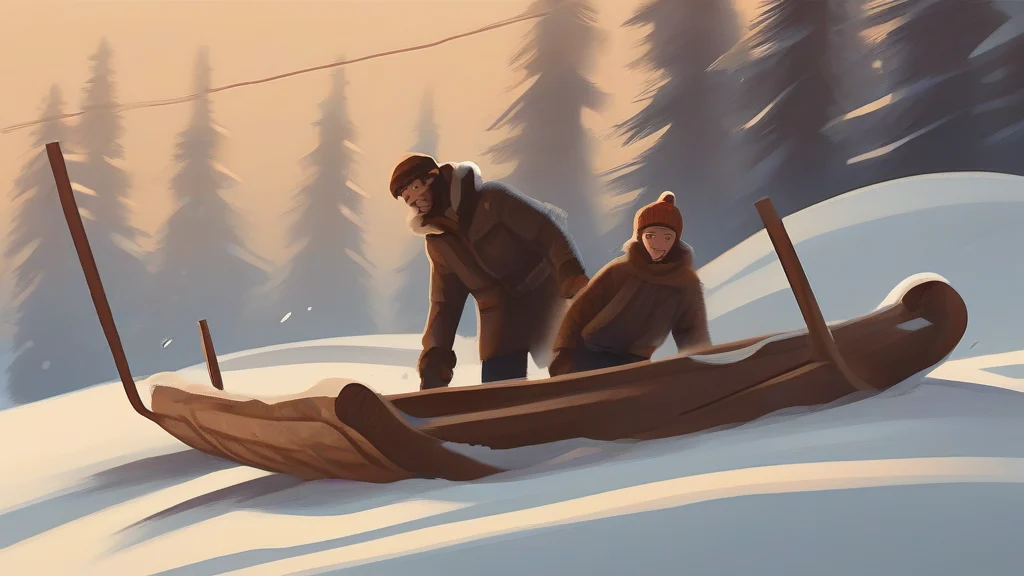
What does sledged mean?
Sledged is the past tense and past participle of sledge, a chiefly British verb meaning to travel or ride on a sledge, a vehicle equipped with runners. The action is most strongly associated with sliding over snow or ice, usually while sitting or lying on the vehicle as it moves downhill. A sentence such as “They sledged down the hill” therefore evokes the speed, cold, and exhilaration of a winter descent. The word is relatively uncommon and appears more often in narrative, recreational, or descriptive contexts than in everyday conversation. It can also be used in the past participle, as in “The equipment was sledged to the campsite,” meaning it was transported by sledge. North American speakers more commonly use sled and sledged for the vehicle itself and sledded for the action.
verbThe past tense and past participle of sledge, meaning to travel or ride on a sledge.
- Travel or ride on a sledge, especially downhill over snow or ice.
"They sledged down the steep, snow-covered hill."
"The children sledged down the hill after the first heavy snowfall."
"Rescue teams sledged the injured climber to the nearby shelter."
Sledged captures the sudden rush of gravity and frost when a runner-equipped sledge carries you downhill.
Reviewed by Deb Chak, Editor. AI-assisted content curated by RJS Tech Solutions LLP.
Where does sledged come from?
The inflected form sledged derives from sledge, which comes from the same northern European linguistic tradition as the English word sled. Both names refer to vehicles that slide over snow on runners. Sledgehammer was formed much later by combining sledge with hammer and originally referred to a heavy hammer designed for use with either hand.
Related word forms
How sledged is actually used
The form is chiefly associated with British English and relatively uncommon in general use. The spelling sledge should not be confused with sled; in North American English, sledded is more usual for the corresponding action.
Easily confused with sledged
A sledge is the chiefly British term for a runner-equipped vehicle and for riding on one, whereas a sled is the usual North American term for a smaller snow vehicle.