
What does sledgehammer mean?
A sledgehammer is a large, heavy hammer with a long handle, designed for breaking hard materials, demolishing structures, and driving wedges. Its name combines “sledge,” an older term related to a sliding vehicle, with “hammer,” and the compound has been in use since the early modern period. Literally, the word refers to a powerful tool for controlled destruction; figuratively, it describes an argument, attack, or competitive defeat delivered with overwhelming force. Because using a sledgehammer is generally excessive when a lighter tool would suffice, the word often conveys bluntness, brute strength, or disregard for proportion. In everyday use, “sledgehammer” is more recognizable as an image of force than as a precise piece of equipment. It is commonly used in expressions such as “a sledgehammer blow” and “sledgehammer force,” and it remains a useful word for describing both physical impact and rhetorically forceful treatment.
A large, heavy hammer with a long handle, used for breaking hard objects or demolishing structures.
"The crew lifted the sledgehammer and struck the concrete block."
Often used figuratively for a blow or force that is especially powerful or disproportionate.
To strike or break something with a sledgehammer, or to attack something with overwhelming force.
"The team sledgehammered the opposing defense in the second half."
The figurative use is common in informal writing and speech and implies a forceful, sweeping attack.
The usual plural of the noun is sledgehammers.
"The crew carried several sledgehammers across the construction site."
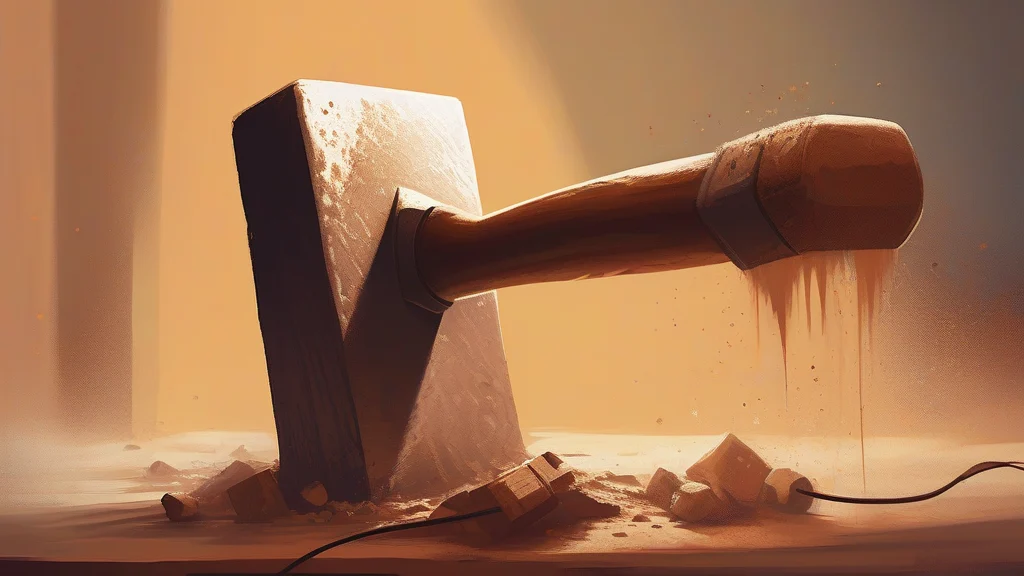
A sledgehammer is designed to deliver a force powerful enough to shatter stone, but the word also evokes a forceful, overwhelming blow in arguments and competition.
Reviewed by Deb Chak, Editor. AI-assisted content curated by RJS Tech Solutions LLP.
Where does sledgehammer come from?
The word developed in the early modern period from “sledge,” a term for a sled or sledge, and the Old English word “hammer.” “Sledge” ultimately derives from Old Norse sléð, while “hammer” comes from Old English hamor, a Germanic word related to cognates in other Germanic languages. The compound originally described a heavy hammer used in demolition or metalworking.
Related word forms
How sledgehammer is actually used
The compound is usually written as one word, although “sledge hammer” is also recognized. As a verb, “sledgehammer” is generally informal or figurative and suggests an attack delivered with overwhelming force.
Easily confused with sledgehammer
A sledge is a vehicle that slides over snow or ice, whereas a sledgehammer is a heavy hammer used for striking or breaking objects.