
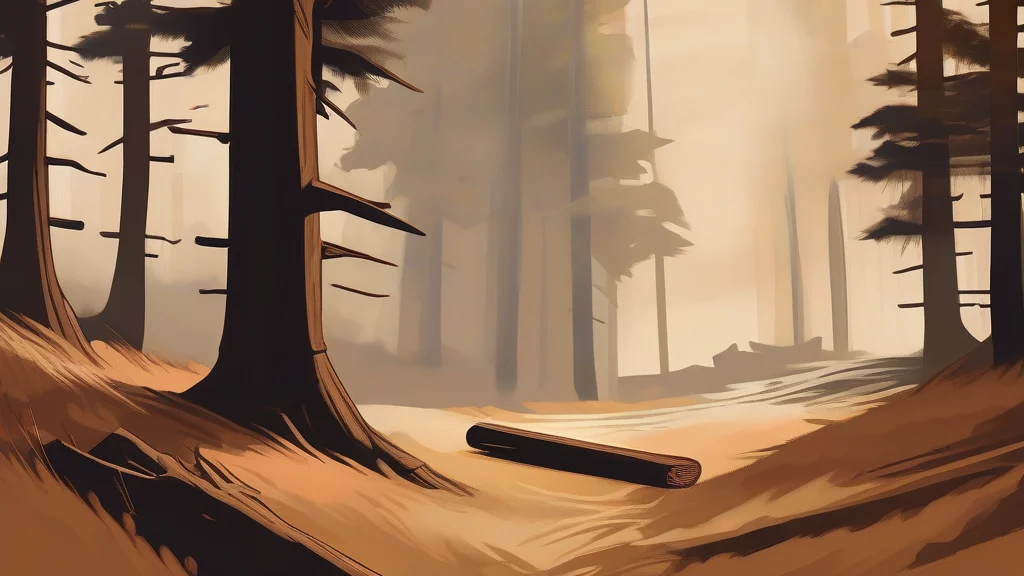
What does stumpage mean?
Stumpage is a noun with several closely related meanings. Most commonly, it refers to the part of a tree trunk that remains after the tree has been cut down, often together with its roots. In another established sense, stumpage means a collection of such remnants, as after land has been cleared or a woodland has been felled. Forestry and the timber trade also use stumpage for standing trees considered collectively as timber to be cut, sometimes referring to their commercial value or the right to harvest them. The word therefore covers both the material left behind by cutting and the trees awaiting cutting. In ordinary landscape descriptions, it emphasizes the physical remains of trees and the condition of the land. Its specialized associations with forestry can make it sound technical, but it remains readily understandable and is especially useful when the focus is on stumps collectively rather than on one individual stump.
nounThe portion of a tree trunk left standing after the tree has been cut down, especially including the roots. It can also refer collectively to tree stumps or to standing trees considered as timber to be felled.
- The portion of a tree trunk remaining after the tree has been cut down, sometimes including the roots.
- A collection or area of tree stumps.
- Standing trees considered collectively as timber available to be cut.
"After the clearing was complete, only the pale stumpage remained across the hillside."
"After the storm, the forest floor was littered with stumpage."
"The logger offered a high price for the timber but left the stumpage in place."
Stumpage is usually used as a mass noun, but the plural can be used when individual stumps or separate areas of stumpage are being counted.
"The survey mapped several stumpages along the boundary."
Stumpage can mean what is left after the tree is cut down—or, in forestry, the trees still standing before they are.
Reviewed by Deb Chak, Editor. AI-assisted content curated by RJS Tech Solutions LLP.
Where does stumpage come from?
The word was formed in English by adding the suffix -age to stump. Stump itself continues Old English stump and is of Germanic origin, while -age is a productive English suffix that can create nouns denoting collections, quantities, or related concepts. English thus developed stumpage with senses extending from an individual tree remnant to a group of stumps and, later, to standing timber.
How stumpage is actually used
The word is most common in forestry, logging, and land-clearing contexts. It has a technical or practical tone, while the older collective sense survives mainly in regional and literary usage.
Easily confused with stumpage
A stump is an individual truncated trunk, whereas stumpage can denote that remaining portion collectively or refer to standing trees as timber to be felled.