
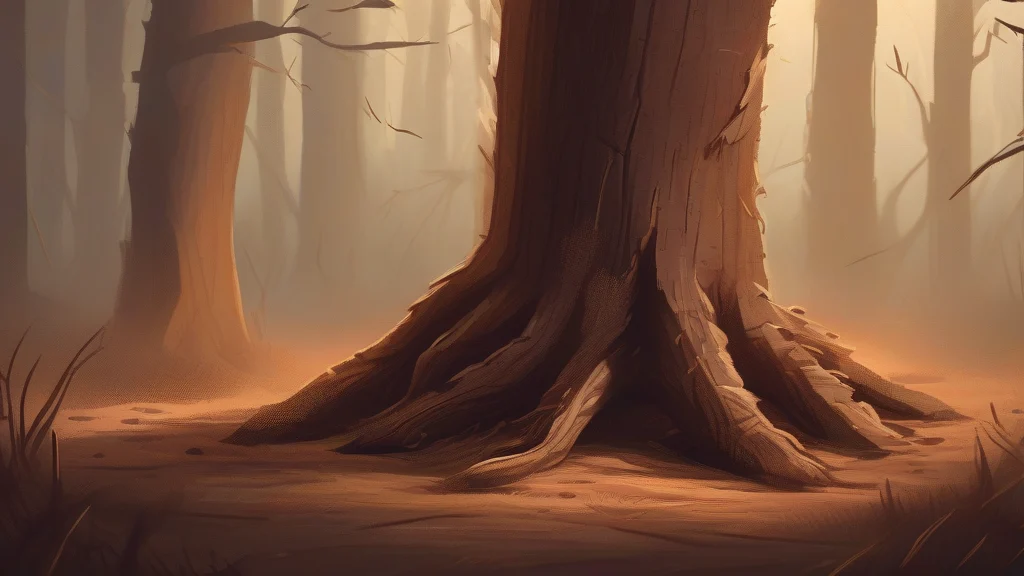
What does stump mean?
A stump is most commonly the short, thick part of a tree trunk or limb that remains after the rest has been cut or broken. The word can also describe a small, blunt-ended remnant, such as a piece left after something has been removed, or the shortened part of an amputated limb. As a verb, 'stump' means to leave someone confused or unable to answer, as in a question that stumps an expert. It can also mean to cut a tree close to the ground or, in a less common literary usage, to move with heavy, deliberate steps. The noun is familiar from descriptions of wooded landscapes and gardens, while the figurative verb is especially useful for describing a problem or question that defeats even a knowledgeable person. The word is used in both British and American English, with no major regional difference in its central meanings.
The short, thick remaining part of a tree trunk or limb after it has been cut or broken; also, a small blunt-ended remnant or the shortened part of an amputated limb.
"The path curved around a large tree stump covered in bright green moss."
The figurative sense 'a small remaining part' is common in general usage, while 'the shortened part of an amputated limb' is more specialized.
To leave someone confused or unable to answer; to thwart or perplex someone. It can also mean to remove the trunk or limbs of a tree close to the ground.
"The final question stumped every contestant on the quiz."
The figurative meaning is widespread and generally informal. The meaning involving cutting a tree is more literal and less frequent.
The regular plural is used for individual pieces of a tree and for figurative remnants, such as the stumps of several branches or careers.
"Workers removed the old tree stumps from the construction site."
A stump can be the remains of a great tree, but the word also means to leave someone so thoroughly perplexed that they cannot respond.
Reviewed by Deb Chak, Editor. AI-assisted content curated by RJS Tech Solutions LLP.
Where does stump come from?
The word comes from Middle English 'stumpe', an older form related to words in several Germanic languages meaning a truncated tree or wooden piece. Its precise Proto-Germanic ancestor is commonly reconstructed as a word meaning a shortened or blunt-ended trunk. Modern cognates include German 'Stumpf' and Dutch 'stomp', while the English derived forms 'stumpy' and 'stumpiness' preserve the idea of being short or blunt-ended.
Related word forms
How stump is actually used
In the figurative sense, 'stump' is informal but common, especially in American English. The verb 'stump' can mean to perplex or thwart someone, and 'stumped' is frequently used to describe a person who is temporarily unable to respond. The sense meaning to walk heavily is relatively uncommon and literary.
Easily confused with stump
A stump is usually the thick, substantial remaining part of a tree trunk or limb, whereas a stub is generally smaller and may refer to a short piece of almost anything, such as a cigarette, ticket, or pen.