
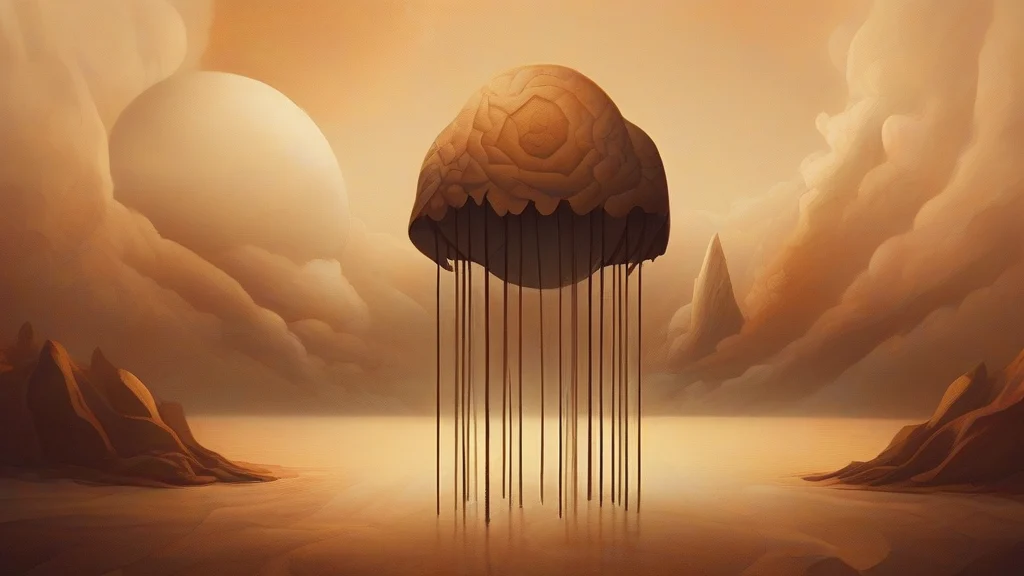
What does surrealism mean?
Surrealism is a twentieth-century artistic and literary movement that challenged conventional ideas of reality, logic, and acceptable subject matter. Associated especially with European artists and writers in the 1920s and 1930s, it sought to bring dreams, unconscious desires, fantasy, and irrational associations into conscious creative expression. Surrealist works may present unexpected juxtapositions, distorted images, dreamlike scenes, or deliberately impossible situations. The word can also describe something so strange or dreamlike that it seems unreal, although in this more general sense the adjective "surreal" is usually more idiomatic. Surrealism differs from ordinary fantasy because it does not simply create an imaginary world; it often disrupts familiar categories and makes the strange appear convincing. Its lasting influence can be seen in modern painting, photography, film, literature, performance, and advertising.
An artistic and literary movement that sought to transcend rational thought and conventional reality by exploring dreams, fantasy, the unconscious, and irrational associations.
"Surrealism emerged as a major force in European art and literature during the 1920s."
When referring specifically to the historical movement, it is usually modified by "surrealist," as in "surrealist art" and "the surrealist movement."
A dreamlike, fantastic, or markedly strange quality in imagery, writing, or experience.
"The film has a dreamlike surrealism that makes ordinary scenes feel subtly threatening."
This sense is less common and is often expressed more naturally by the adjective "surreal."
The plural is rare and is used mainly when referring to different forms or manifestations of surrealism.
"The exhibition explores the surrealisms of dreams and memory across several artistic movements."
Surrealism took the unreal seriously: its artists treated dreams, contradictions, and the irrational as subjects for art.
Reviewed by Deb Chak, Editor. AI-assisted content curated by RJS Tech Solutions LLP.
Where does surrealism come from?
The word was formed in the early twentieth century from the French word "surréalisme," a derivative of "surréaliste," itself based on "surréal," meaning "beyond reality." The term developed from French avant-garde artistic and literary experiments and entered English during the period when surrealism became an international movement. Related English forms include "surreal" and "surrealist," while cognates appeared in languages such as Spanish, Italian, German, and Portuguese.
Related word forms
How surrealism is actually used
The term most commonly refers to the historical movement, especially in its association with 1920s and 1930s European art and literature. As an attributive noun, it is usually written as "surrealism" before another noun, as in "surrealism art"; "surrealist art" is also common. In the second sense, "surreal" is generally more natural than "surrealism" for describing a particular work or effect.
Easily confused with surrealism
Surrealism is an artistic and literary movement, whereas surreal describes something so unusual or dreamlike that it seems beyond ordinary reality.