
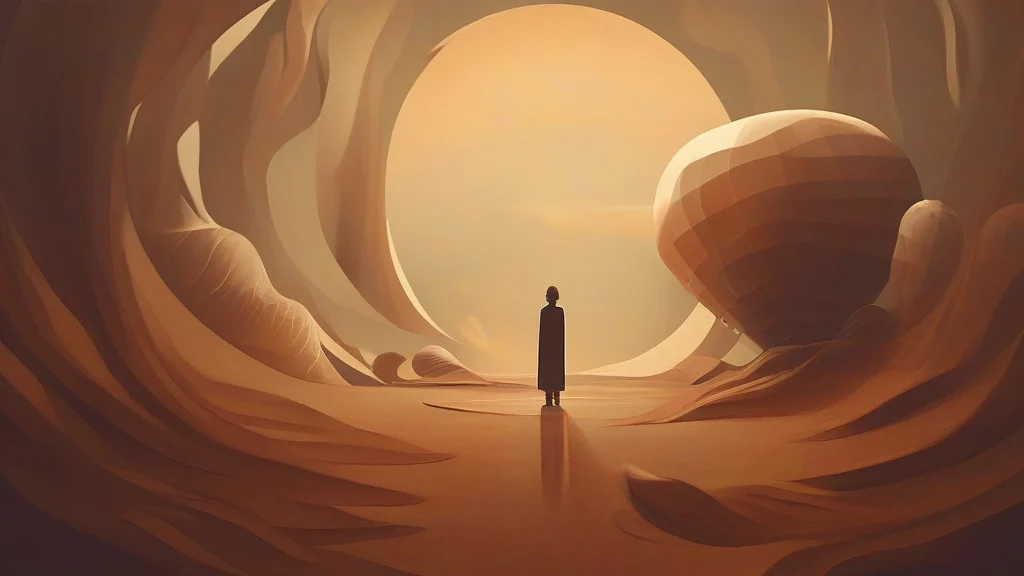
What does surreal mean?
Surreal describes something dreamlike, unreal, or so strange that it seems disconnected from ordinary life. The word can characterize an image, narrative, experience, or event that evokes the quality of a dream: familiar things appear in unexpected combinations, logic becomes uncertain, and reality seems suspended. In formal discussion of the arts, surreal often refers more broadly to the imaginative, irrational qualities associated with the Surrealist movement. In journalism and everyday speech, it commonly conveys that something is bizarre, uncanny, or bizarrely unreal. A sentence such as "the deserted railway platform had a surreal atmosphere" uses the word to create a sense of dreamlike estrangement, while "the situation became surreal" emphasizes disorder, absurdity, or difficulty in making sense of events. Surreal differs from surrealistic, which more specifically describes works inspired by Surrealism.
Dreamlike, unreal, uncannily strange, or contrary to ordinary reality.
"The film presents a surreal version of suburban life in which time behaves unpredictably."
Commonly used both attributively and predicatively. In art criticism it denotes dreamlike or irrational qualities; in general use it may mean extremely strange or unsettling.
The Surrealist movement, considered as an artistic and intellectual movement.
"The gallery staged an exhibition exploring the influence of the surreal on twentieth-century photography."
This noun form is uncommon in general usage and normally appears with an initial capital when referring to the historical movement.
The word surreal entered English through the Surrealist movement, whose artists sought to free the imagination from ordinary logic and reality.
Reviewed by Deb Chak, Editor. AI-assisted content curated by RJS Tech Solutions LLP.
Where does surreal come from?
The word comes from French surréalisme and the related surréaliste, terms closely associated with the Surrealist movement. The movement's name was devised in the 1920s, with André Breton's 1924 Surrealist manifesto helping establish its terminology. Its components combine the prefix sur-, meaning "beyond," with réel, the French word for "real," reflecting an attempt to move beyond ordinary reality and conventional thought. English later developed the adjective surreal alongside the established nouns surrealism and surrealist.
Related word forms
How surreal is actually used
Surreal is widely used in art, criticism, journalism, and informal description. It is commonly used predicatively, as in "the scene felt surreal," and attributively, as in "a surreal dream." In artistic contexts, it can describe imagery or experiences associated with dreamlike irrationality; in general use, it often means simply extremely strange or unsettling.
Easily confused with surreal
Surreal describes something with a dreamlike or unreal quality, whereas surrealistic usually describes a work or style associated with the Surrealist movement.