
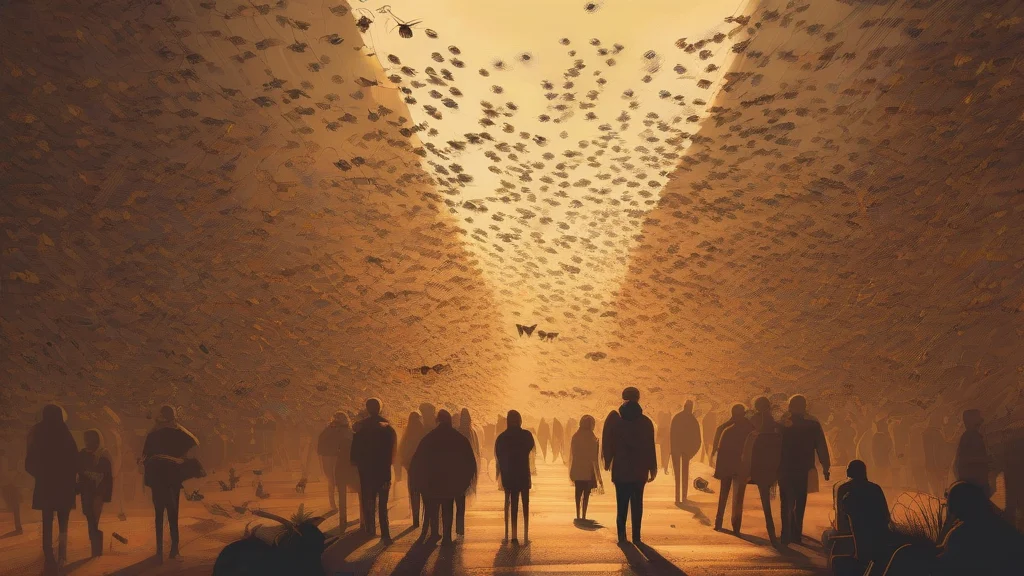
What does swarming mean?
Swarming is the act of moving or gathering in a dense, numerous group, especially as insects do, and the resulting mass of animals or people. As a noun, it can name an instance of this behaviour; as an adjective, it may describe something filled with such movement. The word is also figurative: a place may be said to be swarming with life, while a public event can become swarming with reporters or protesters. These uses carry a suggestion of abundance and activity, though they can also imply crowding, disorder, or infestation depending on context. Swarming is especially characteristic in descriptions of bees, termites, locusts, and other social insects, but it applies naturally to crowds moving together in a dense mass. The vocabulary is useful because it captures both the physical fact of collective movement and the figurative idea of being crowded or alive with activity. It differs from simply being numerous: swarming emphasizes collective motion and density, giving the word a vivid, energetic quality in reports, nature writing, and descriptive prose.
To move or gather together in a large, dense group, especially as insects or other animals do.
"Locusts swarmed across the fields, consuming nearly every crop."
Often used in the present participle form, as in “swarming insects,” and figuratively for people moving through or occupying a place in large numbers.
An instance or act of moving or gathering in a dense group, especially a group of insects.
"The swarming of the termites was visible from the edge of the property."
Most often used in phrases such as “the swarming of bees” or “the swarming of locusts.”
Covered with or composed of a swarm; figuratively, crowded with people, insects, or activity.
"A swarming mass of reporters filled the entrance to the courthouse."
This use often functions as a participial adjective and may suggest either energetic abundance or troublesome crowding.
Rare and chiefly used for separate instances of swarming; the mass noun is normally left singular.
"Seasonal swarmings of termites were observed after the rains."
Swarming captures the moment a scattered multitude becomes one dense, moving cloud.
Reviewed by Deb Chak, Editor. AI-assisted content curated by RJS Tech Solutions LLP.
Where does swarming come from?
The modern word descends from Old English swearm, meaning a multitude, crowd, or swarm of bees. Its deeper ancestor is reconstructed as Proto-Germanic *swarmaz, with cognates including German Schwarm and Dutch zwerm. The English word developed both the general sense of moving or gathering in a crowd and the more specific associations with groups of insects.
How swarming is actually used
The term is neutral when used as a factual description but often suggests dense, energetic, and potentially chaotic movement. Figurative uses may be approving, as with a place swarming with life, or disapproving, as with an area swarming with pests.