
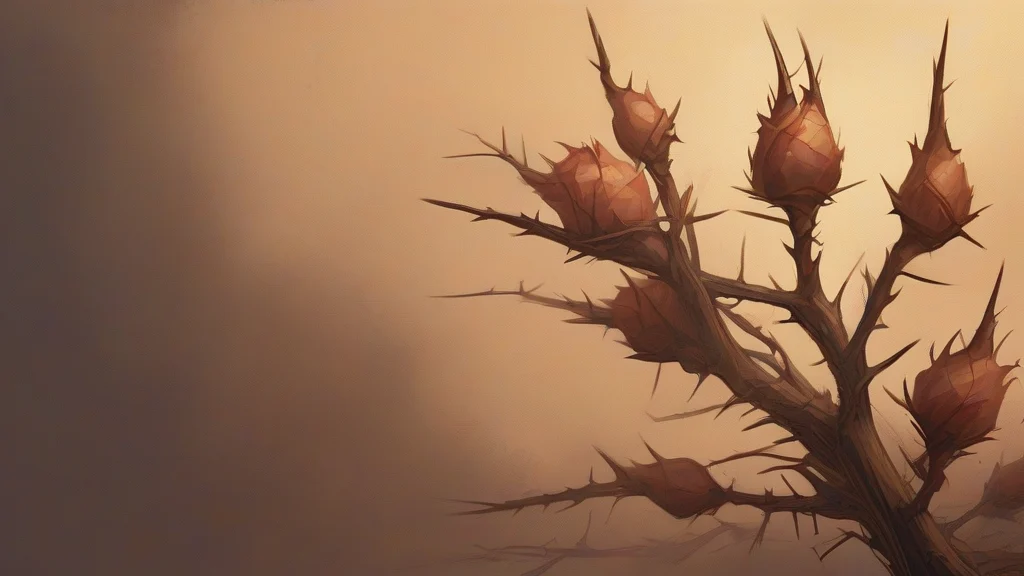
What does thorn mean?
A thorn is the sharp, rigid point that projects from the stem or branch of a plant such as a rose, hawthorn, or bramble. Such projections can protect the plant from browsing animals, but they can also catch clothing, injure handlers, and make thick vegetation difficult to move through. In figurative English, a thorn is a troublesome person, issue, or circumstance—an obstacle that is irritating or persistently troublesome. The expression “a thorn in one's side” is especially familiar and describes something continually inconvenient or irritating. Thorn is also the source of the widely used adjective thorny, which applies both to plants bearing sharp projections and to problems, discussions, or personalities that are difficult and contentious. Because the word combines a vivid physical image with a metaphorical sense of difficulty, it is useful when describing both literal obstacles and the recurring annoyances of everyday life. Its old Germanic history also connects it with cognates in several European languages, making it one of the familiar words that links modern English to a much older vocabulary.
A sharp, pointed projection on the stem, branch, or other part of a plant; figuratively, a source of difficulty or persistent annoyance.
"The rose's thorns caught her sleeve as she tended the hedge."
The figurative sense is common in both formal and informal English, often describing a recurring annoyance or a troublesome issue.
To prick or cause pain with a thorn; figuratively, to irritate, annoy, or cause persistent difficulty for someone.
"The rough bark thorned his hands as he worked."
The verb is relatively uncommon and is chiefly literary or figurative.
The plural refers to multiple sharp plant projections or, figuratively, to several sources of difficulty or annoyance.
"Thorns surrounded the path, making the journey slower and more painful."
The word thorn also gives us thorny, a memorable adjective for anything difficult, contentious, or resistant to easy solutions.
Reviewed by Deb Chak, Editor. AI-assisted content curated by RJS Tech Solutions LLP.
Where does thorn come from?
The English word descends from Old English þorn, inherited from Proto-Germanic *þurną. It is cognate with German Dorn, Dutch doorn, Danish torn, and Swedish törn, all referring to a sharp plant projection. The modern English form continued this Germanic word, while derivatives such as thorny and thornless were formed within English.
Related word forms
How thorn is actually used
The noun is neutral in literal use. Its figurative use is common and often suggests an annoyance that is small in scale but persistent in effect; the verb is comparatively rare and literary.
Easily confused with thorn
A thorn is a sharp projection on a plant, whereas torn is the past participle of tear, meaning ripped or split.