
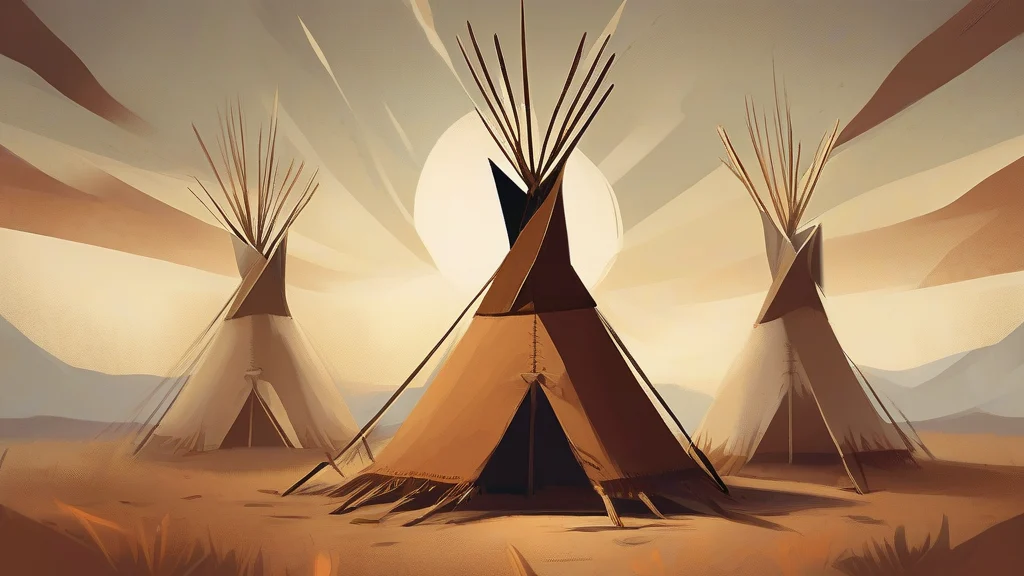
What does tipi mean?
Tipi, also written teepee or tepee, names a portable, conical dwelling associated with the Indigenous peoples of the North American Plains. Traditionally, a tipi was made from a framework of poles covered with sewn buffalo hides; modern reproductions and event structures may use other materials. In English, “tipi” can denote either the historically specific shelter or a tent designed in that form. The word is especially associated with the Lakota and other Plains cultures and should be used with awareness that a tipi is a particular cultural structure, not a generic name for every tent. Its compact, portable design made it well suited to movement across the Plains. The term also survives in contemporary educational, artistic, and ceremonial contexts. Although “teepee” was historically common in English, “tipi” is the familiar modern spelling and more closely reflects its Dakota source.
nounA portable, conical dwelling traditionally made from a pole framework and sewn animal hides, used by some Indigenous peoples of the North American Plains. The term may also refer to modern tents or structures modeled on this traditional form.
- A portable, conical dwelling or tent associated with the Indigenous peoples of the North American Plains.
"The guide explained how the tipi was assembled, covered, and secured against the wind."
"The guide explained how the tipi was assembled, covered, and secured against the wind."
"At the cultural center, visitors learned about the history and construction of a Plains tipi."
The regular plural of tipi is tipis.
"The historical display featured several tipis representing different Plains communities."
Designed for a mobile way of life, a traditional tipi could be raised quickly, dismantled, and carried to another campsite.
Reviewed by Deb Chak, Editor. AI-assisted content curated by RJS Tech Solutions LLP.
Where does tipi come from?
English borrowed tipi in the 19th century from Dakota, also called Lakota, where the related verb ti means “to dwell” and the corresponding noun denotes a dwelling. The borrowing reflects the close historical relationship through which English speakers entered the terminology of Plains Indigenous life. Related English spellings include teepee and tepee, while the Dakota verb ti remains a close etymological relative.
Related word forms
How tipi is actually used
The term is chiefly used in North American English and usually carries a specific association with Plains Indigenous cultures rather than referring generically to any tent. In educational, artistic, and ceremonial contexts, it is also used for structures modeled on the traditional shelter.
Easily confused with tipi
Teepee is an alternate spelling of the same word rather than a different kind of dwelling.