
What does teepee mean?
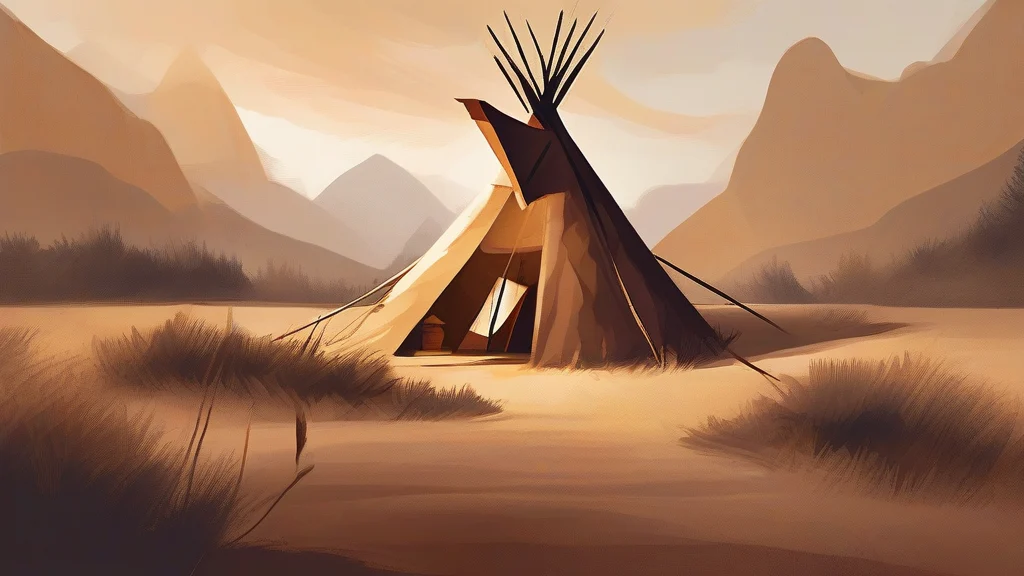
A teepee is a portable, conical shelter traditionally associated with Indigenous peoples of North America. Its frame is formed from poles that meet or cross near the top, while covers traditionally made from animal hides, bark, or later canvas protect its occupants from the weather. Such dwellings could be taken down, transported, and raised again, making them especially suitable for communities that moved across the plains. In modern English, teepee can refer either to a shelter built in this traditional style or, more figuratively, to a tent or structure with a similar conical shape. The word is often encountered in historical, educational, and cultural contexts, including accounts of life on the Plains. Although tipi is also widely used, teepee remains a familiar spelling and is readily understood by English speakers. The word is also notable as a direct English borrowing from an Indigenous language of the Algonquian family.
nounA portable, conical tent traditionally made from poles covered with hides, bark, or other materials and used by Indigenous peoples of North America. The word may also refer more generally to a small tent with a similar shape.
- A portable, conical tent traditionally used by Indigenous peoples of North America, formed from poles and covered with hides, bark, canvas, or other materials.
"The guide explained how the teepee was traditionally constructed and how its design suited life on the open plains."
"Families at the cultural gathering toured the reconstructed teepees and discussed traditional ways of living on the plains."
"The temporary art installation resembled a giant teepee made from brightly colored panels."
The standard plural is teepees, pronounced /ˈtiːpiːz/. It is used when referring to more than one tent or shelter of this type.
"Several teepees stood near the edge of the camp."
A classic tipi could be raised in minutes and carried across the prairie: its ingenious cone could withstand the wind from every direction.
Reviewed by Deb Chak, Editor. AI-assisted content curated by RJS Tech Solutions LLP.
Where does teepee come from?
English borrowed teepee from Ojibwe, an Algonquian language of the Great Lakes region. The Indigenous source word has also entered English in the spellings tipi and tippee. Its precise deeper history is less certain, but the borrowing reflects the long-standing contact between English-speaking settlers and Indigenous peoples of North America.
Related word forms
How teepee is actually used
Teepee is standard in general English and neutral in tone. Some writers and Indigenous communities prefer the spelling tipi, particularly when discussing the specific traditions of a particular nation; a more precise cultural term may be appropriate in that context.
Easily confused with teepee
Tipi is a common spelling variant of teepee and refers to the same traditional conical tent rather than to a different kind of dwelling.