
What does tunicate mean?
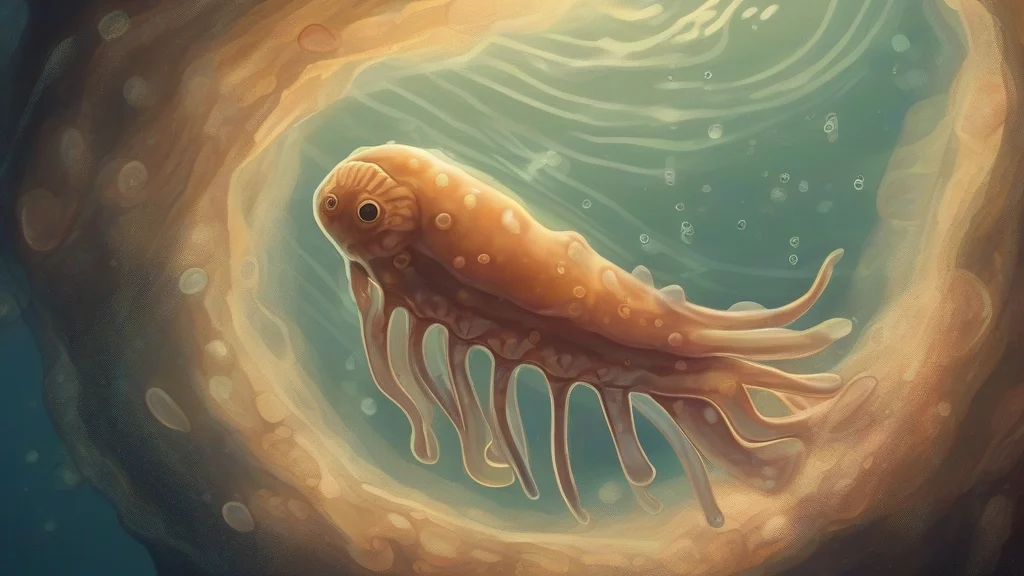
Tunicate is most commonly used as a noun for a marine chordate, an animal related to vertebrates but lacking a backbone. Tunicates include sea squirts, salps, and larvaceans, and many live attached to rocks, docks, seaweed, or other submerged surfaces. Their name refers to the tough, flexible tunic surrounding the body, which can release a fine jet of water when the animal is disturbed. Many tunicates draw seawater through an internal filter to obtain food, making them familiar sights on piers and underwater structures. The word can also function as an adjective meaning clothed in a tunic or covered by a tunic-like layer. In older and literary contexts, tunicate is a verb meaning to put a tunic on someone. Although its zoological sense is the dominant modern usage, all of these forms share a history connected with the Latin word for a tunic or garment.
A marine chordate animal with a flexible, tunic-like covering, such as a sea squirt, salp, or larvacean.
"A tunicate attached itself to the submerged rail of the pier."
This is the dominant modern sense and is standard in biological and marine-science contexts.
Wearing a tunic, covered by a tunic, or possessing a tunic-like outer covering.
"The image showed a tunicate figure in a long draped garment."
The sense referring to an animal's tunic-like covering is technical; the sense referring to clothing is uncommon outside literary or historical writing.
To clothe someone in a tunic.
"The priest tunicates the acolytes before the procession."
This use is literary, historical, or archaic and is not common in everyday English.
The standard plural is tunicates, as in “a colony of tunicates.”
"Several tunicates were clustered around the entrance to the harbor."
Tunicates are chordates without a backbone whose simple-looking outer covering gives their entire group its name.
Reviewed by Deb Chak, Editor. AI-assisted content curated by RJS Tech Solutions LLP.
Where does tunicate come from?
English tunicate comes through New Latin from Latin tunicātus, meaning “clothed in a tunic” or “wearing a tunic.” The Latin word derives from tunica, the ordinary term for a tunic or other close-fitting garment. The zoological noun developed from this clothing-related word because tunicates possess a body covering resembling a tunic, while the related English noun tunic and anatomical term tunica continue to preserve the same Latin root.
Related word forms
How tunicate is actually used
The zoological noun is standard in biology and marine science. The adjective is relatively uncommon and can describe a person dressed in a tunic or an animal or object covered by one. The verb is literary, historical, or deliberately archaic rather than everyday usage.
Easily confused with tunicate
A tunic is a loose garment, whereas a tunicate is an animal, a tunic-clad person or thing, or the rare verb meaning to clothe someone in a tunic.