
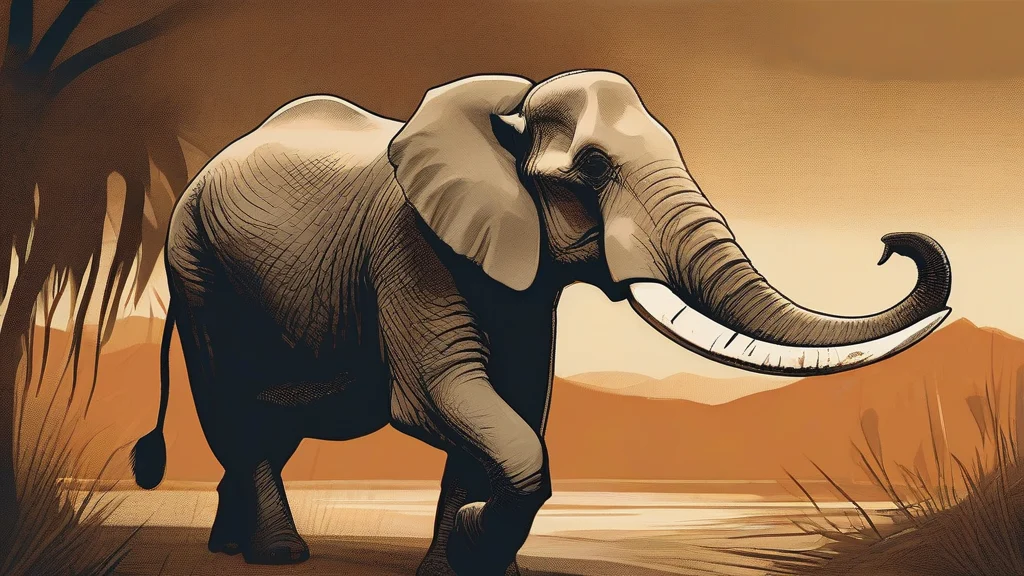
What does tusker mean?
Tusker most commonly denotes an elephant distinguished by its tusks, often an adult male with prominent tusks. The word has a traditional, literary quality and is less usual in everyday zoo and wildlife language, where “elephant” is normally preferred. In South Asian hunting contexts, a tusker may specifically mean an elephant trained to assist a hunter in pursuing game. An older and less common sense refers to a wild boar with visible tusks. The word can therefore suggest both an impressive wild animal and, historically, a working animal employed in hunting. Its formation is transparent: adding the suffix “-er” to “tusk” produces a noun literally meaning “one that has tusks.” Even when no tusks are visible, the term may retain its association with large, imposing animals.
nounA tusk-bearing elephant. The term can also refer to a wild boar with tusks or, in South Asian hunting contexts, to an elephant trained to hunt game.
- An elephant with tusks, especially a mature male elephant.
- An elephant trained to hunt game, particularly in South Asian hunting traditions.
- A wild boar with prominent tusks.
"A lone tusker appeared at the edge of the forest as the herd moved deeper into the hills."
"The herd included several young elephants, but only one magnificent tusker led the males."
"The mahout guided the trained tusker through the forest in pursuit of wild boar."
The standard plural is “tuskers.”
"Two tuskers stood guard at the edge of the camp."
Tusker puts an elephant's most famous feature up front: tusks.
Reviewed by Deb Chak, Editor. AI-assisted content curated by RJS Tech Solutions LLP.
Where does tusker come from?
Tusker is an English formation from “tusk” plus the suffix “-er,” literally meaning “one that has tusks.” Its principal modern sense is a tusk-bearing elephant, while the older application to other tusked animals accounts for its wild-boar sense.
Related word forms
How tusker is actually used
The word is less common in everyday modern English, where “elephant” is usually sufficient. The hunting-elephant sense is particularly associated with South Asia, while the wild-boar sense is comparatively uncommon.
Easily confused with tusker
A tusk is an individual projecting tooth, whereas a tusker is an animal that has tusks.