
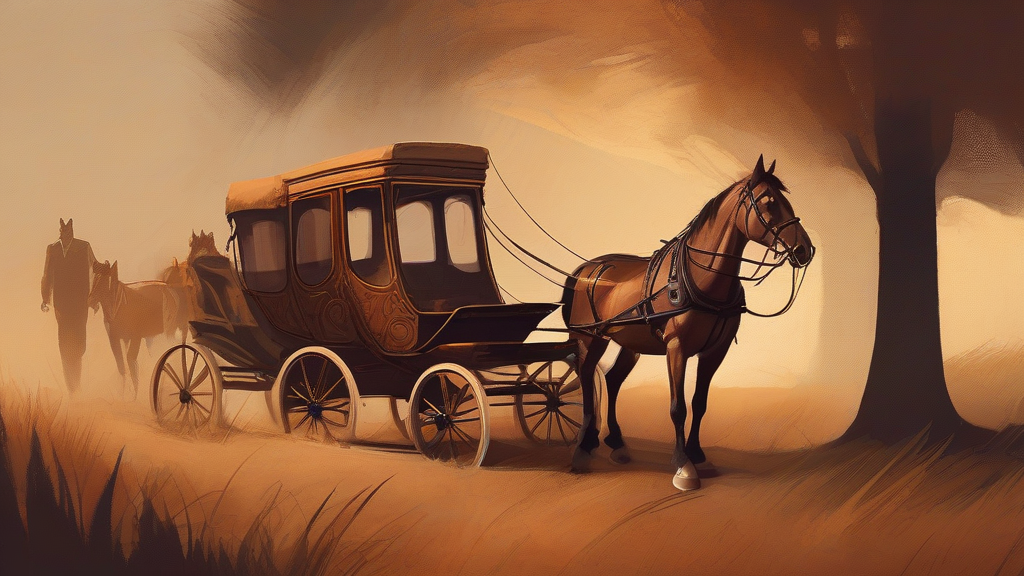
What does vettura mean?
Vettura is a rare, chiefly literary noun for a carriage or similar horse-drawn vehicle. The word is not normally needed for modern transport, but it gives period prose a precise, old-fashioned label for the coach in which passengers were carried through city streets or country roads. A vettura can evoke pre-automobile travel, with its open or covered body, horse, driver, and surrounding period detail. Because the term is uncommon, it normally sounds deliberately elegant or historical rather than neutral. It fits naturally into descriptions of novels, memoirs, travel writing, or settings in earlier centuries. Its derivation from Latin adds interest: vettura belongs to a wider family of words about carrying, transport, and conveyance, including vehicle and vector. For readers enlarging their vocabulary, vettura is especially useful as a vivid marker of historical transport and literary atmosphere rather than as a term for everyday travel.
nounA carriage, coach, or similar passenger vehicle, especially one drawn by horses. The word is now chiefly literary or historical.
- A carriage, coach, or wagon, especially a horse-drawn passenger vehicle.
"A coachman waited beside the open vettura as the passengers descended."
"A single vettura waited outside the town house as the evening rain began to fall."
"The novel's opening scene takes place inside a hired vettura crossing the crowded capital."
The regular English plural is vetture, which takes a plural verb.
"Several vetture waited outside the inn."
The vettura comes through Italian from the Latin vectūra, literally a carrying—making it a living relic of the age of horse-drawn transport.
Reviewed by Deb Chak, Editor. AI-assisted content curated by RJS Tech Solutions LLP.
Etymology of vettura
The English noun was borrowed from Italian vettura, a general term for a carriage or vehicle. Italian vettura continues Latin vectūra, “carriage, transport,” formed from vectus, the past participle of vehere, “to carry.” This Latin root also underlies English words such as vehicle and vector, as well as related terms including vection and convection.
Related word forms
How vettura is actually used
Rare and generally literary, archaic, or deliberately period-flavored in modern English. It is more evocative than descriptive and is uncommon in everyday speech.