
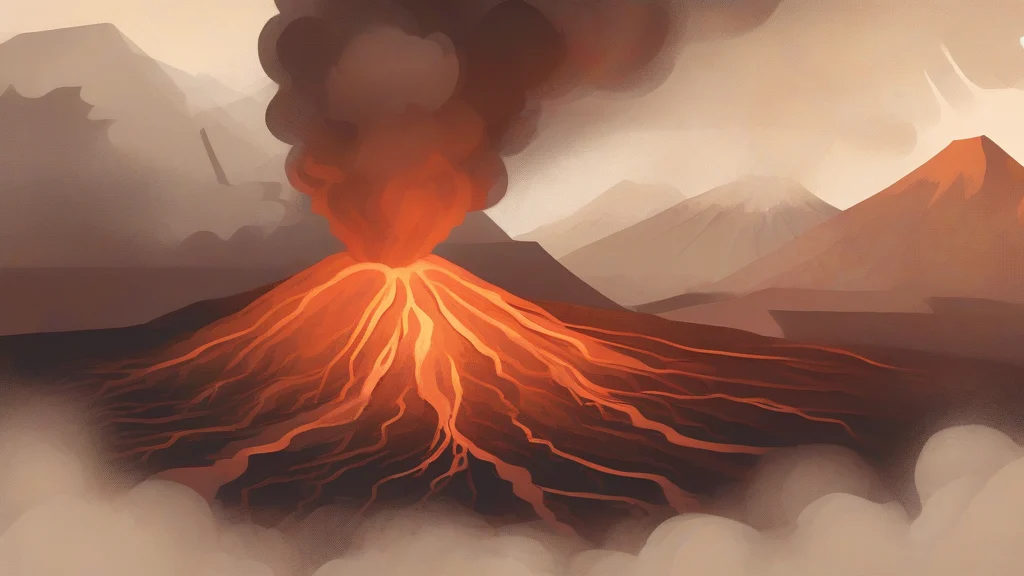
What does volcano mean?
A volcano is a geological structure or opening in Earth's crust through which molten rock, ash, gases, and other material may escape. It is often a cone-shaped mountain built by repeated eruptions, although the word can also refer more narrowly to the vent itself. Scientists describe volcanoes as active, dormant, or extinct and study their activity through volcanology. In ordinary use, volcano is a neutral factual noun; figuratively, it can describe a tense situation whose conflicts may suddenly erupt, as in “a political volcano.” The word is used internationally, with only minor pronunciation differences between British and American English. Volcano is also the source of related forms such as volcanic and volcanism and belongs to an etymological family that includes Vulcan, the Roman god of fire. Understanding the distinction between a volcano, a crater, and a caldera helps prevent a common misconception: a volcano is the whole eruptive structure or system, not simply the depression at its summit.
nounA geological structure or opening in Earth's crust through which lava, ash, gases, and other volcanic material may erupt, often forming a cone-shaped mountain.
- A geological structure, often a cone-shaped mountain, containing an opening through which volcanic material can escape.
- Figuratively, a tense or volatile situation in which suppressed conflicts may suddenly erupt.
"Mount Vesuvius is a volcano whose eruption in 79 CE buried the Roman cities of Pompeii and Herculaneum."
"The volcano had been dormant for centuries before tremors began beneath its summit."
"The disputed legislation turned the committee meeting into a political volcano."
Volcanoes is the standard and more common plural; volcanos is a traditional variant that remains in occasional use.
"Several volcanoes in the region show signs of seismic activity."
Volcano takes its name from Vulcano, a volcanic island in the Aeolian Islands whose name invokes Vulcan, the Roman god of fire.
Reviewed by Deb Chak, Editor. AI-assisted content curated by RJS Tech Solutions LLP.
Where does volcano come from?
English borrowed the word in the early 17th century from Italian vulcano, named after Vulcano, one of the Aeolian Islands off Sicily. The island's name derives from Latin Vulcanus, the Roman god of fire and metalworking. Through this name, volcano is connected with cognates including vulcanize and vulcanology.
Related word forms
How volcano is actually used
The word is neutral and factual in general use. Its figurative sense is common in journalism and political discussion, where it emphasizes rapidly intensifying conflict or instability.
Easily confused with volcano
A volcano is an eruptive structure or vent, whereas a caldera is a broad basin formed by collapse after a large eruption.