
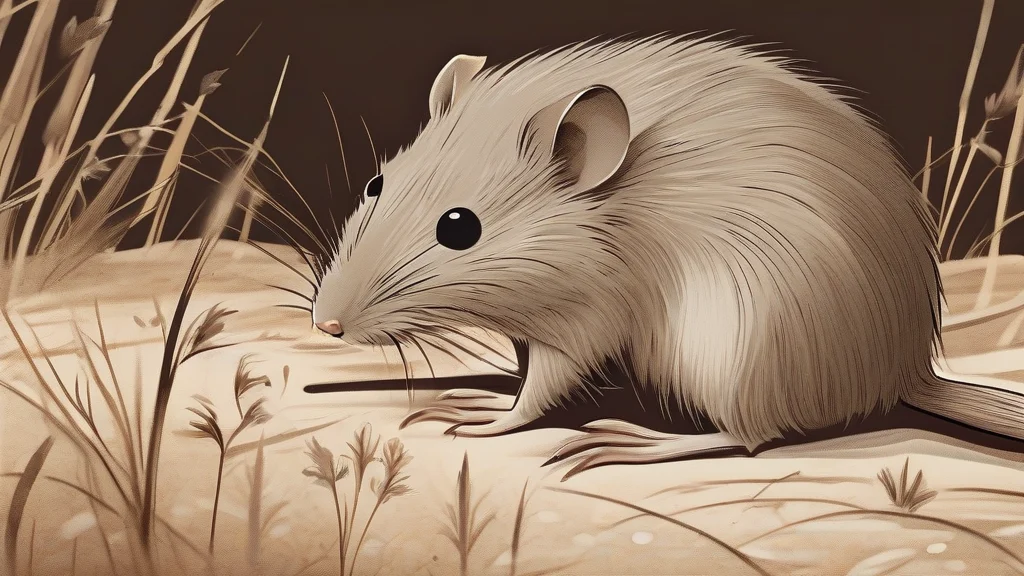
What does vole mean?
In English, a vole is a small-to-medium rodent in the subfamily Arvicolinae, a group that includes voles, lemmings, and muskrats and belongs to the larger mouse family Muridae. The best-known members are field voles and bank voles, which live in grassy or wooded ground, while water voles occupy streams, lakeshores, and wetlands and are considerably larger. Voles have compact bodies, blunt noses, small ears, and relatively short tails; unlike true house mice, they generally do not live as household pests. In everyday English, the word is most often used in biological or wildlife contexts, and it is normal in both British and American speech. Calling a mouse-like animal a vole is therefore a fairly precise description rather than a casual synonym for any mouse. The word also recognizes a distinctive group of rodents that may resemble mice but differ in anatomy, behavior, and habitat. Voles form an important part of the diets of owls, foxes, weasels, and other predators, making even a familiar garden visitor part of a much larger ecological network.
nounA vole is any of various small-to-medium, mostly burrowing rodents in the subfamily Arvicolinae, characterized generally by a compact body, blunt nose, small ears, and relatively short tail. Some species, notably the water vole, are considerably larger than a house mouse.
- Any of various small-to-medium, mostly burrowing rodents in the subfamily Arvicolinae, including field, bank, and water voles.
"At dusk, a bank vole emerged from the grass beside the hedgerow."
"A vole tunneled through the snow beneath the garden fence."
"The reserve's wetland supports a large population of water voles."
The standard plural is “voles.”
"Several voles disappeared beneath the grass as the owl approached."
A water vole can be nearly the size of a small rat—an impressive expansion of the humble “mouse.”
Reviewed by Deb Chak, Editor. AI-assisted content curated by RJS Tech Solutions LLP.
Where does vole come from?
The English noun entered Middle English through Old French vole and Medieval Latin vola, both of which referred to a field mouse. Latin vola has sometimes been connected with volare, meaning “to fly,” perhaps because of the animal's quick movements, although that proposed etymological relationship is uncertain.
Related word forms
How vole is actually used
The word is standard in both British and American English and is most natural in biological, agricultural, and wildlife contexts. Zoologically, it refers specifically to members of Arvicolinae rather than to all mouse-like rodents.
Easily confused with vole
A vole is a mouse-like rodent with a blunt face and short tail, whereas a mole is a burrowing mammal with a pointed snout, velvety fur, and broad forefeet adapted for digging.