
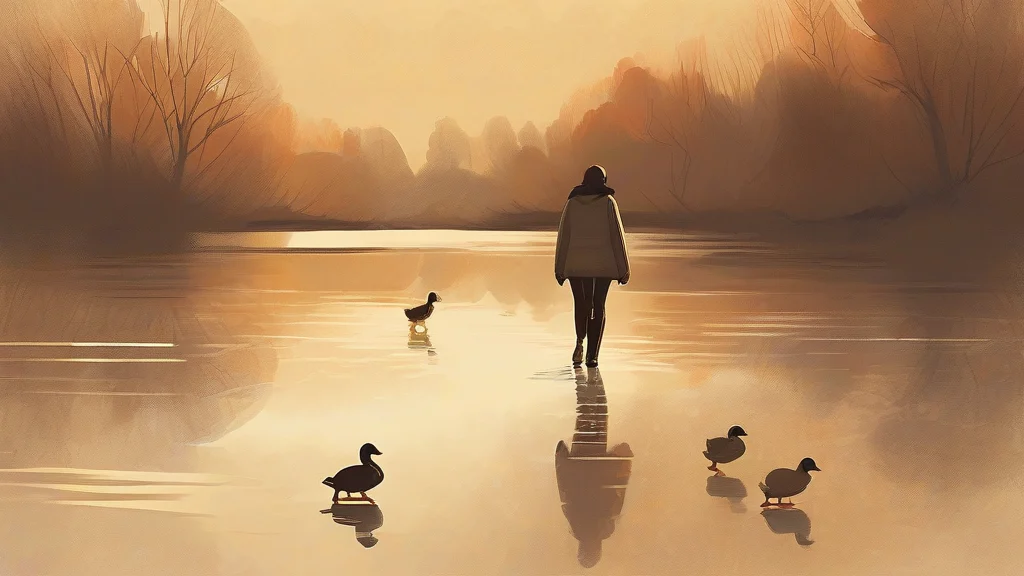
What does waddling mean?
Waddling describes movement in short, slightly unsteady steps, usually with a pronounced side-to-side sway. It is most immediately associated with broad-bodied birds, especially ducks, but people also waddle when carrying an awkward load, walking awkwardly, or recovering from an injury. As a verb form, “waddling” presents an action in progress: the duck was waddling toward the water. As an adjective, it characterizes a gait, as in a “waddling walk,” while as a noun it names the action or manner of moving. The word often carries a humorous or gently teasing tone when applied to people, suggesting that the movement is slow, ungainly, or comically determined. Figuratively, “waddling” can describe progress that seems lumbering or cumbersome. It is a vivid word because it turns a recognizable rhythm of steps into both a precise description and an easily imagined scene.
To walk with short steps and a swaying, side-to-side motion.
"The old dog waddled stiffly toward the door."
As a present participle or gerund, this form describes an action in progress.
Having a gait characterized by short steps and a swaying, side-to-side motion.
"The penguin crossed the path with its characteristic waddling walk."
Often descriptive or humorous rather than hostile when applied to a person.
The action or manner of walking with short, swaying steps.
"Her waddling across the uneven ground looked almost comical."
Most often used in the singular or as an uncountable activity noun.
The plural is rare; the singular or uncountable form is usual.
"The film captured the duck's awkward waddlings across the yard."
A duck may look graceful on the water, but on land even its ordinary stroll becomes a comedy of sideways motion.
Reviewed by Deb Chak, Editor. AI-assisted content curated by RJS Tech Solutions LLP.
Where does waddling come from?
Waddling was formed by adding the present-participle and gerund suffix -ing to waddle. The verb waddle is recorded from the early 17th century for moving with short steps, especially with a side-to-side motion. Its deeper origin is uncertain, and no equally certain family of non-English cognates can be safely identified.
Related word forms
How waddling is actually used
The term is neutral or gently humorous when describing animals but may sound lightly critical or teasing when applied to a person's gait or conduct. Figurative use suggests conspicuously slow or cumbersome progress.
Easily confused with waddling
Waddle is the base verb and can also name the action or manner itself, whereas waddling is the -ing form used as a present participle, gerund, or adjective.