
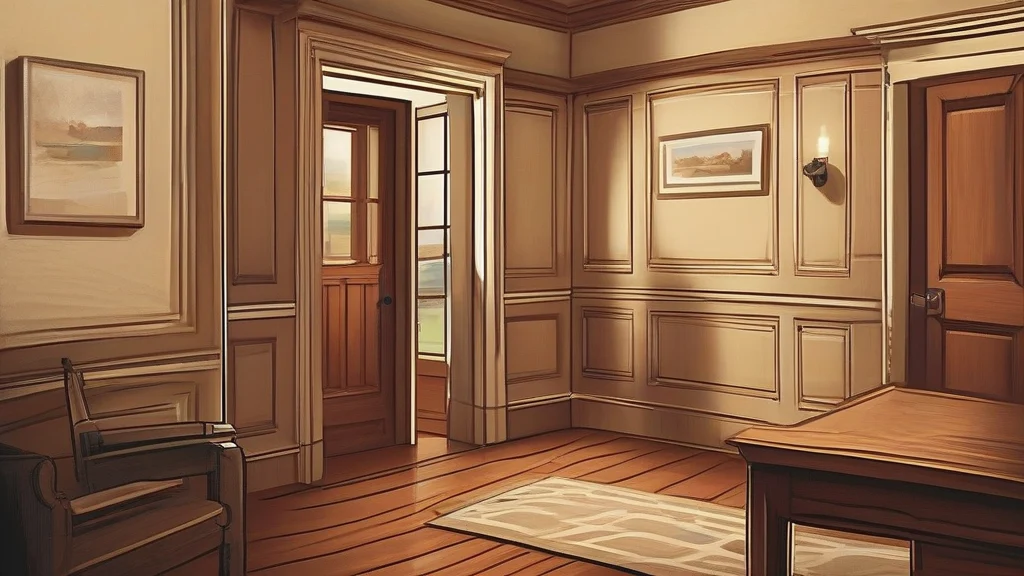
What does wainscoting mean?
Wainscoting is decorative wooden paneling fitted to the lower portion of an interior wall, usually ending at or near a chair rail. It may consist of solid boards, raised panels, beadboard, or another traditional wood finish, and it is especially associated with older homes, formal dining rooms, studies, and other traditional interiors. The word can denote the paneling material itself, the installation process, or the completed wall surface. Its appearance helps give a room a period character, whether through dark oak, painted paneling, or simpler designs. In North American English, “wainscoting” is a familiar architectural term; in British English, “panelling” is often more common, though both terms are understood. The word is ultimately borrowed from a Dutch compound associated with wagon shelters, a history reflected in its surviving relatives “wain” and “wagon.”
nounWooden paneling or the material used to panel the lower part of an interior wall, typically below a chair rail. The term may also refer to the finished paneled wall surface.
- Wooden paneling, or the material used, for covering the lower part of an interior wall.
"Dark wooden wainscoting lends the study a stately, traditional character."
"The original oak wainscoting was carefully restored throughout the hallway."
"Contractors installed white beadboard wainscoting in the breakfast room."
"Period homes often feature dark wainscoting beneath a chair rail."
The plural is rare because “wainscoting” is normally treated as a mass noun.
"The auction included several original wainscotings from the early twentieth century."
Wainscoting began with a word for a wagon shelter: even its name carries a trace of the carts and rooms of the past.
Reviewed by Deb Chak, Editor. AI-assisted content curated by RJS Tech Solutions LLP.
Where does wainscoting come from?
English borrowed “wainscot” from Dutch “wainschot” or “wagenschot,” a compound formed from elements meaning wagon and protection, shelter, or partition. The base word entered English in the early 17th century, while the form “wainscoting” developed in the 19th century. The element “wain” is related to “wagon,” both descending from a Germanic word for a vehicle.
Related word forms
How wainscoting is actually used
The word is especially common in North American English. British speakers often use “panelling” or “wood panelling,” although “wainscoting” is also understood. It normally describes woodwork on the lower part of a wall rather than paneling applied across the entire wall.
Easily confused with wainscoting
Wainscoting refers to the finished paneling treatment or its installation, while a wainscot is a panel or the paneled lower portion of a wall.