
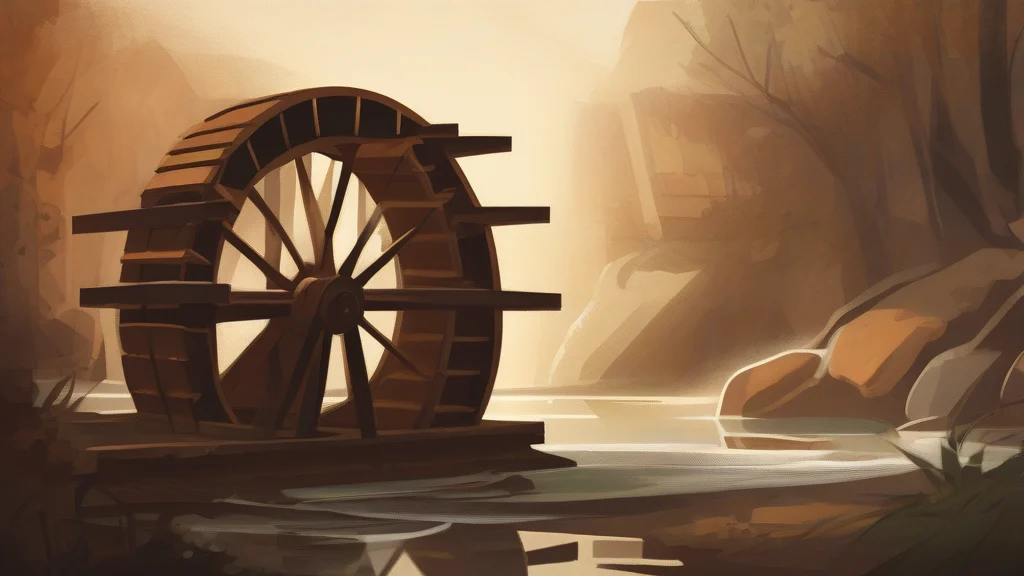
What does waterwheel mean?
A waterwheel is a wheel turned by flowing water. Its paddles, buckets, or blades capture the force of a stream or river, and the resulting rotation can raise water, grind grain, or drive other machinery. Waterwheels have been used for centuries and are especially associated with watermills, although they have also powered irrigation works and early industrial equipment. Their design varies with the available current: undershot wheels are driven from below by fast-flowing water, while overshot wheels receive water from above and generally operate more efficiently. The word carries a strong historical and rural association, evoking traditional mills and preindustrial technology, but it is also used in modern descriptions of heritage sites and renewable-energy systems. Although “water wheel” is sometimes written as two words, “waterwheel” is the standard closed form of the noun.
nounA wheel with paddles, buckets, or blades that is turned by flowing water to raise water, grind grain, or drive machinery.
- A wheel fitted with paddles, buckets, or blades that is driven by flowing water to raise water, grind grain, or operate machinery.
"The old waterwheel beside the mill still turns when the river is in flood."
"An undershot waterwheel raised water into the millrace."
"The museum's waterwheel demonstrates how river power once drove industrial machinery."
The regular plural is waterwheels.
"Several working waterwheels line the river."
Long before steam engines, a wheel turning in a river could grind grain, irrigate fields, and power machines.
Reviewed by Deb Chak, Editor. AI-assisted content curated by RJS Tech Solutions LLP.
Where does waterwheel come from?
The word is an English compound formed from “water” and “wheel” and is attested from the Middle English period. “Wheel” comes from Old English hwēol, which derives from Proto-Germanic *kwehwrą and has close cognates in Old Norse hjól, Dutch wiel, and German Rad. The compound developed in the context of water-powered milling, irrigation, and the raising of water.
Related word forms
How waterwheel is actually used
The term is primarily historical, agricultural, and technical, though it remains common in heritage, engineering, and environmental contexts.
Easily confused with waterwheel
A watermill is the building or installation powered by a waterwheel, whereas a waterwheel is the rotating wheel itself.