
What does whisker mean?
Whisker most often means one of the hairs growing on a person's face, particularly on the cheeks or chin, although the plural 'whiskers' is normally used for facial hair collectively. The word also refers to the long, sensitive hairs around the muzzle of animals such as cats. These hairs function as tactile sensors, helping an animal detect obstacles and judge the position of nearby surfaces. More generally, 'whisker' can denote a fine projecting filament, and in older nautical terminology it refers to a small outrigger or spar on a vessel. In ordinary use, the word is somewhat more literary than 'facial hair,' but it remains natural when describing an individual hair or the characteristic whiskers of an animal. Singular and plural meanings overlap: a single whisker can be discussed as an individual structure, while 'whiskers' usually denotes the complete set.
A hair on the human face, especially on the cheeks or chin, or a similar tactile hair projecting from the muzzle of an animal.
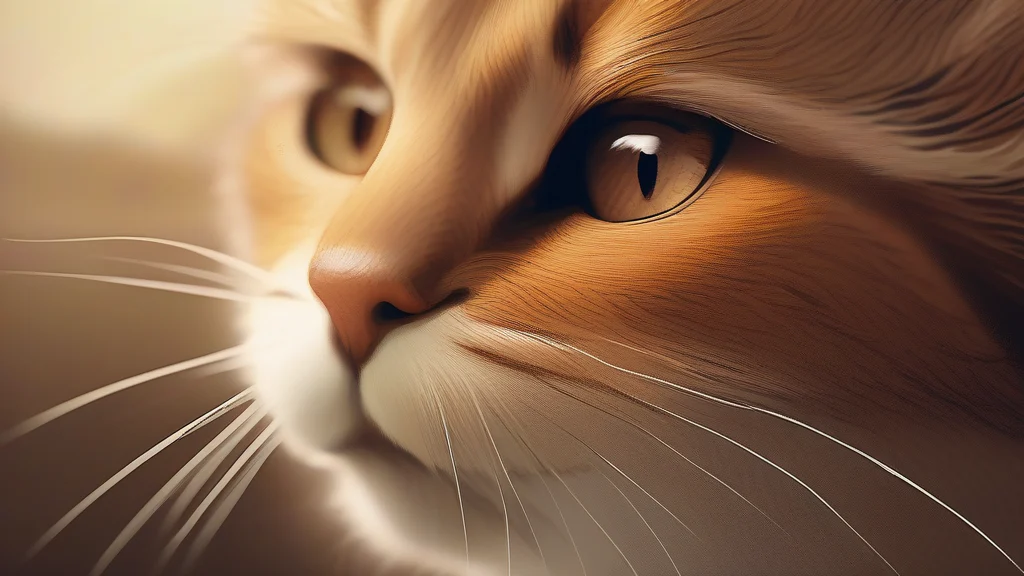
"The cat turned its head, its whiskers briefly catching the light."
Usually plural when referring collectively to facial or animal hair; singular is used for an individual hair or in technical contexts. The nautical sense is specialized and relatively rare.
To form or grow whiskers; to furnish something with whiskers.
"The young goat whiskers slowly in the spring."
Rare and more characteristic of literary or technical language than everyday speech.
The plural is the normal form when referring collectively to facial hair or to an animal's tactile hairs. Singular 'whisker' is used for an individual hair.
"His neatly trimmed whiskers gave him the appearance of an old sea captain."
A cat's whiskers are not merely decorative hairs: they are highly sensitive instruments that help an animal sense nearby objects and navigate in the dark.
Reviewed by Deb Chak, Editor. AI-assisted content curated by RJS Tech Solutions LLP.
Where does whisker come from?
The word entered Middle English as 'wiskere', usually understood as a diminutive of 'whisk'. The underlying vocabulary belongs to a Germanic family traced to Proto-Germanic *wisk-, associated with wiping or brushing, with a related form recorded in Old Norse as 'wisk'. The sense developed from a tuft or projecting hair to the modern references to facial and animal hairs.
Related word forms
How whisker is actually used
The plural 'whiskers' is the normal form when referring to a person's facial hair or an animal's sensory hairs. Singular 'whisker' is common when emphasizing one individual hair and is also standard in technical descriptions. The verb is rare and is not part of everyday general English.
Easily confused with whisker
A whisker is a facial or animal hair, whereas a whisk is a small kitchen tool used for beating or whisking ingredients.