
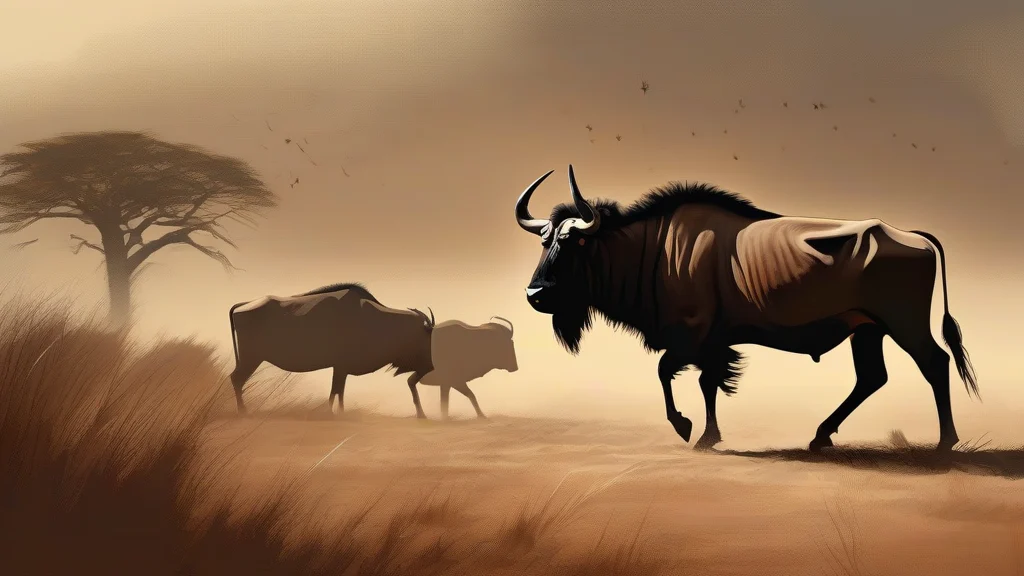
What does wildebeest mean?
Wildebeest is the English name for a group of large African antelopes native to eastern and southern Africa. The best-known members are the blue wildebeest and black wildebeest, both distinguished by a broad forehead, curved horns, beard, sloping back, and powerful build. Wildebeest occur in enormous herds and are especially associated with the seasonal migrations of the Serengeti and Maasai Mara ecosystems, where large numbers cross rivers in search of fresh grazing. The word is neutral rather than derogatory and is common in wildlife reporting, conservation writing, travel descriptions, and environmental studies. “Gnu” is a well-established alternative name, while “wildebeeste” is a variant spelling associated particularly with South African English. Wildebeest are ecologically significant because their grazing helps maintain open grasslands and influences the movement and distribution of many other animals. The term is therefore both a precise zoological label and a familiar symbol of one of the animal kingdom’s most remarkable migrations.
nounA large African antelope of the genus Connochaetes, characterized by a sloping back, large head, and beard. The blue and black wildebeest are the two commonly recognized species.
- A large African antelope of the genus Connochaetes, especially the blue wildebeest or black wildebeest.
"A herd of wildebeest crossed the open plain as the sun began to rise."
"Tourists watched thousands of wildebeest gather near the river before the annual crossing."
"The conservationist studied how grazing wildebeest shape the grassland ecosystem."
The unchanged plural wildebeest is traditional and especially common in wildlife contexts; wildebeests is also accepted.
"Thousands of wildebeest migrated across the valley."
Its name literally means “wild beast,” yet the wildebeest is famous for one of the world's longest great migrations.
Reviewed by Deb Chak, Editor. AI-assisted content curated by RJS Tech Solutions LLP.
Etymology of wildebeest
Wildebeest entered English in the eighteenth century from Afrikaans wildebeest, a compound of wilde “wild” and beest “beast.” Afrikaans in turn adapted the Dutch compound wildebeest, whose components ultimately correspond to English “wild” and “beast.” The literal translation “wild beast” is apt, although the name does not indicate any close resemblance to a bovine.
How wildebeest is actually used
The term is neutral and widely used in wildlife reporting, conservation writing, and descriptions of African landscapes. “Gnu” is a common alternative name in English, while “wildebeeste” is especially associated with South African usage.
Easily confused with wildebeest
Wildebeeste is an alternative South African spelling of wildebeest and refers to the same antelope rather than to a different animal.