
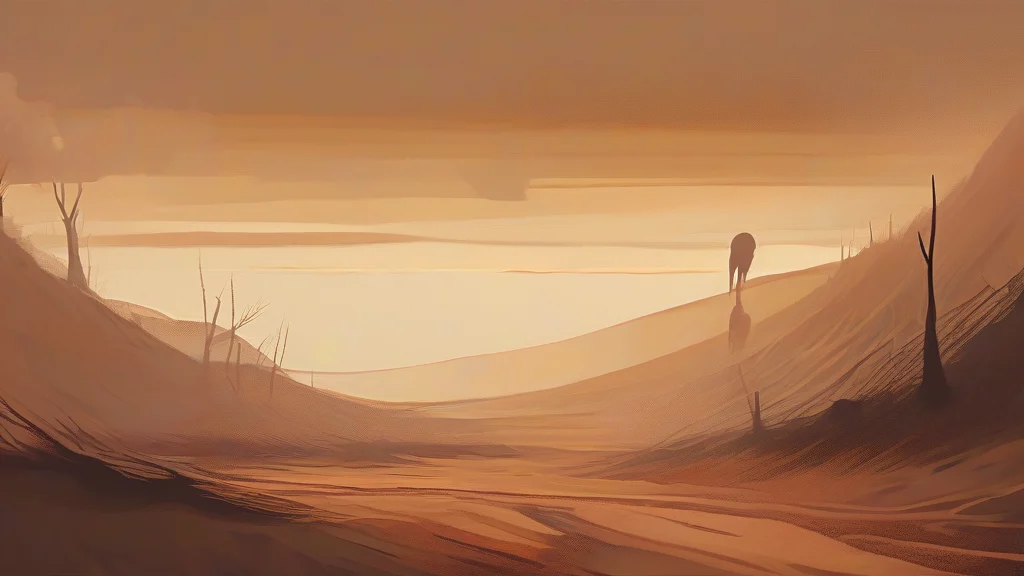
What does witheredness mean?
Witheredness names the state of being withered, especially the visible condition of something that has dried, shriveled, or diminished. Its literal use often describes vegetation, fruit, wood, or flesh that has lost moisture and vitality. Figuratively, it can describe institutions, traditions, landscapes, or people marked by decline, stagnation, and an inability to renew themselves. The word commonly carries a somber and somewhat poetic tone, making it more evocative than neutral words such as “decay” or “decline.” Although “witheredness” is closely related to the familiar verb “wither,” it emphasizes the resulting condition rather than the process itself. It is especially effective when the gradual loss of freshness or strength is the focus. In modern English, however, it remains relatively uncommon outside formal, literary, or deliberately descriptive writing.
nounThe condition or quality of being withered, especially dry, shriveled, or diminished. Figuratively, it refers to decline, decay, or loss of vitality.
- The physical condition of being dry, shriveled, or diminished.
- The figurative state of decline, staleness, or loss of vitality.
"The witheredness of the old oak told the story of years of neglect."
"The witheredness of the flowers made the conservator examine them more carefully."
"Her essays captured the witheredness of institutions that had long ceased to adapt."
Uncommon; witheredness is normally treated as an abstract or mass noun.
"The exhibition contrasted the subtle witherednesses of several decaying flowers."
From the shriveling of a single leaf to the decay of an entire era, witheredness scales one idea from physical deterioration to spiritual decline.
Reviewed by Deb Chak, Editor. AI-assisted content curated by RJS Tech Solutions LLP.
Where does witheredness come from?
The word was formed by adding the suffix “-ness” to “withered,” turning the adjective into a noun denoting the resulting condition. “Wither” comes from Old English forms meaning “to become dry, decay, or wither” and is generally traced through Proto-Germanic to an Indo-European root associated with dryness. The suffix “-ness” is a productive English mechanism for creating abstract nouns from adjectives.
How witheredness is actually used
Formal to literary and uncommon in ordinary speech. It is often used to convey a sustained physical deterioration or a figurative sense of age, decay, and lost vitality.
Easily confused with witheredness
Witheredness is a condition of drying, shriveling, or losing vitality, whereas wilderness is land that remains uncultivated and wild.