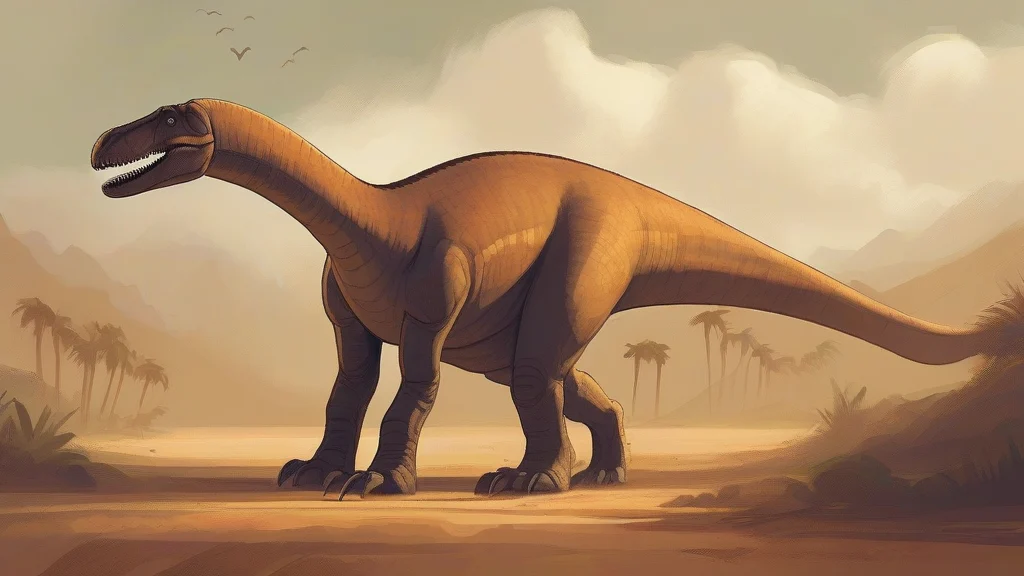
What does diplodocus mean?
A diplodocus is one of the largest land animals ever to have lived: a plant-eating dinosaur that roamed North America during the Late Jurassic period, roughly 150 million years ago. Instantly recognizable by its extraordinarily long neck, whip-like tail, and comparatively tiny head, it belonged to a group of dinosaurs known as sauropods, whose members all shared this distinctive body plan. Measuring up to around eighty or ninety feet in length despite feeding only on low-lying vegetation, Diplodocus has become one of the most iconic dinosaurs in popular imagination, thanks largely to full skeletal casts displayed in major museums around the world. In everyday English the word functions as a noun, typically capitalized when naming the genus precisely but often used loosely for any giant long-necked dinosaur. Its blend of scientific pedigree and popular fame makes it a staple of children's books, documentaries, and museum exhibits alike.
nounA very large herbivorous dinosaur of the Late Jurassic period, characterized by an extremely long neck and tail and a small head; it belongs to the group of sauropod dinosaurs. The name is also used more generally for any gigantic sauropod dinosaur.
- A genus of large, long-necked sauropod dinosaur of the Late Jurassic period.
- Any very large sauropod dinosaur resembling this genus (informal or generalized use).
"The museum's centerpiece is a complete Diplodocus skeleton stretching nearly ninety feet from snout to tail."
"Visitors marveled at the towering cast of a Diplodocus dominating the natural history museum's main hall."
"Like a Diplodocus wading through ferns, the enormous machine moved slowly across the landscape."
Both the Anglicized plural 'diplodocuses' and the Latin-style 'diplodoci' are attested; the former is far more common in modern usage.
"The exhibit compared the skeletons of several diplodocuses side by side."
Diplodocus had a tail so long—over forty feet—that scientists believe it may have cracked it like a whip, producing a sound louder than a cannon blast.
Reviewed by Deb Chak, Editor. AI-assisted content curated by RJS Tech Solutions LLP.
Etymology of diplodocus
The word 'Diplodocus' was coined in the nineteenth century by American paleontologist Othniel Charles Marsh, who named the genus after a distinctive feature of its vertebrae. It derives from Ancient Greek, combining 'diploos' meaning 'double' with 'dokos' meaning 'beam' — a reference to the double-beamed chevron bones beneath the dinosaur's tail vertebrae. The Greek root 'diplo-' appears in many other English words, such as 'diploma' and 'duplicate', which likewise convey the idea of doubling or twofold structure.
How diplodocus is actually used
When referring to the specific dinosaur genus, 'Diplodocus' is conventionally capitalized. The informal plural 'diplodocuses' is common in general English, though the Latinate plural 'diplodoci' also appears in scientific writing.
Easily confused with diplodocus
Brontosaurus is a different (though related) sauropod genus with a heavier build, whereas Diplodocus is a distinct genus known for its exceptionally long, whip-like tail.