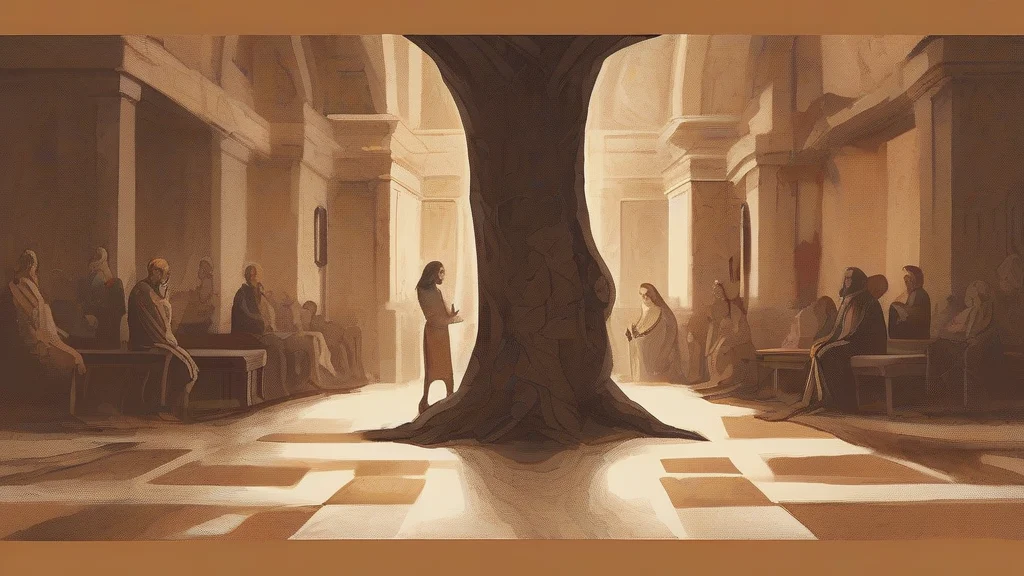
What does allegory mean?
An allegory is a narrative or visual work in which the surface story carries a second, deeper meaning: its characters, places, and events stand for abstract ideas, moral qualities, or real people and institutions. In John Bunyan's Pilgrim's Progress, for example, the hero's name is literally Christian and his journey represents the soul's passage through life toward salvation; in Orwell's Animal Farm, rebellious farm animals enact the Russian Revolution. Allegory differs from a simple metaphor in being extended and systematic — the symbolism runs through the whole work rather than appearing in a single image. The word functions mainly as a noun but also names the broader technique, as in 'the artist's use of allegory.' Common in literary criticism, art history, and film analysis, it is a formal term with no particular emotional charge, valued because it lets readers and viewers discuss how stories say one thing while meaning another.
nounA story, poem, or picture in which the characters, events, and settings symbolically represent deeper moral, political, or spiritual meanings beyond their literal surface.
- A narrative (story, poem, film, or artwork) in which characters and events symbolically represent abstract ideas or real-world figures, conveying a hidden moral, political, or spiritual meaning.
- The technique or practice of using such symbolic representation in art or literature.
"George Orwell's Animal Farm is an allegory of the Russian Revolution, with farm animals standing in for historical figures."
"Pilgrim's Progress follows Christian on a journey that allegorizes the soul's path to salvation."
"The novel works as a political allegory, its dystopian regime thinly veiling contemporary authoritarianism."
Standard plural, used when referring to multiple allegorical works or instances.
"Medieval cathedrals are filled with allegories of virtue and vice."
Dante packed his entire medieval worldview into one journey through Hell — and called it a comedy.
Reviewed by Deb Chak, Editor. AI-assisted content curated by RJS Tech Solutions LLP.
Etymology of allegory
Allegory comes from the Greek 'allegoria', formed from 'allos' ('other') and 'agoreuein' ('to speak in the assembly'), so it literally means 'speaking otherwise' — saying one thing while meaning another. The term passed into Latin as 'allegoria' and entered English in the late Middle Ages, becoming established in literary criticism during the Renaissance. Its Greek roots make it cognate with words built on 'allos', such as 'alien' and 'parallel', reflecting the shared idea of otherness or difference.
Related word forms
How allegory is actually used
Allegory is primarily a term of literary and art criticism; it appears most often in academic writing, reviews, and discussions of literature, film, and painting. It carries no strong connotation of praise or blame, though calling a work 'an allegory' often implies the symbolic layer is deliberate and sustained rather than incidental. The plural 'allegories' is standard when referring to multiple works or instances.
Easily confused with allegory
An allergy is a medical hypersensitivity reaction, whereas allegory is a literary device of symbolic storytelling.
An analogy is a direct comparison between two things to explain one by the other, while an allegory is a sustained narrative whose entire surface meaning stands for a deeper one.