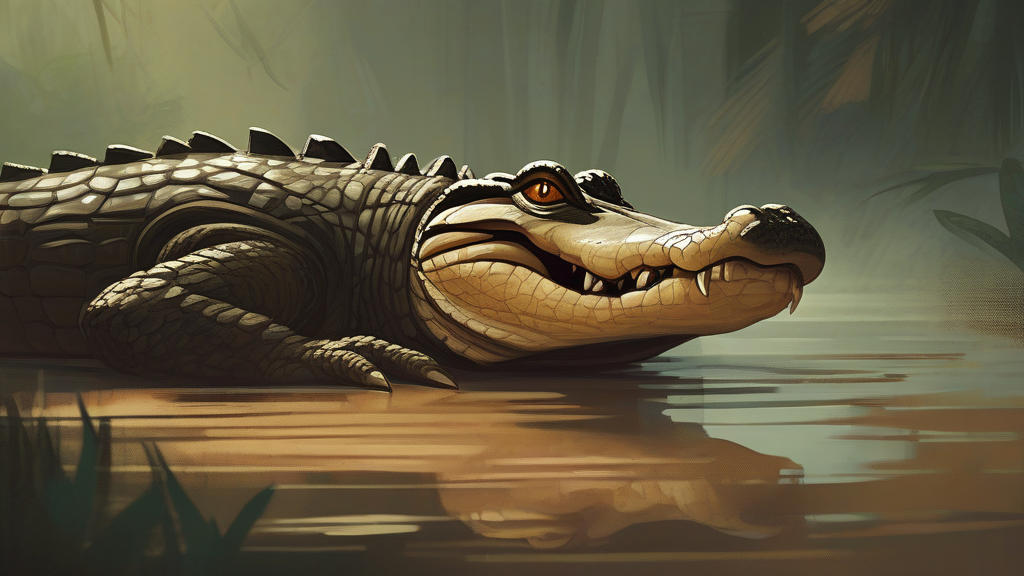
What does alligator mean?
An alligator is a large, semiaquatic reptile belonging to the genus Alligator, one of two living groups of crocodilians alongside true crocodiles. Two species survive today: the American alligator, abundant in the freshwater swamps, marshes, and rivers of the southeastern United States, and the much rarer Chinese alligator of the Yangtze River basin. Alligators are distinguished by their broad, rounded snouts, dark armored bodies, and habit of keeping their lower teeth hidden when the mouth is closed. The word entered English in the sixteenth century as a garbled rendering of Spanish 'el lagarto,' meaning 'the lizard.' In casual American speech it is commonly shortened to 'gator,' and the phrase 'see you later, alligator' has become a familiar pop-culture farewell. Beyond the animal itself, the term also refers to the prized leather made from its hide, long associated with luxury footwear and accessories. Powerful, prehistoric-looking, and unmistakably tied to the wetlands of the American South, the alligator occupies a vivid place in language and imagination alike.
A large semiaquatic crocodilian reptile of the genus Alligator, characterized by a broad rounded snout and armored skin; native to the southeastern United States and eastern China.
"Tourists on the airboat tour saw several alligators basking along the canal bank."
Often shortened informally to 'gator' in American English, particularly in the southern United States.
Leather tanned from the hide of an alligator, used especially in high-end shoes, handbags, and luggage.
"He splurged on a pair of polished alligator boots for the wedding."
Typically used attributively, as in 'an alligator belt'; carries strong connotations of luxury.
Regular plural; the leather sense is usually treated as uncountable or used attributively rather than counted.
"The bayou is home to hundreds of alligators."
The word 'alligator' is actually a mangled English attempt at Spanish 'el lagarto' — literally 'the lizard' — from the early days of Spanish exploration in Florida.
Reviewed by Deb Chak, Editor. AI-assisted content curated by RJS Tech Solutions LLP.
Etymology of alligator
The word 'alligator' comes from Spanish 'el lagarto,' meaning 'the lizard,' which Spanish explorers used for the large reptiles they encountered in the Americas in the sixteenth century. Early English forms such as 'allegarto' and 'alligarta' show how colonists reshaped the Spanish phrase into a single word, settling into its modern spelling by the seventeenth century. The underlying root is Latin 'lacertus' or 'lacerta,' meaning lizard, which also gives us the word 'lizard' itself through a separate route.
How alligator is actually used
In everyday American English, especially in the South, people often shorten the word to 'gator.' The leather sense is used attributively (an alligator bag) and carries connotations of luxury. Alligator is also a genus name in zoology, so it may be capitalized in formal scientific contexts.
Easily confused with alligator
Crocodiles have narrower, V-shaped snouts and visible lower teeth when the mouth is closed, while alligators have broader U-shaped snouts and live mainly in freshwater.