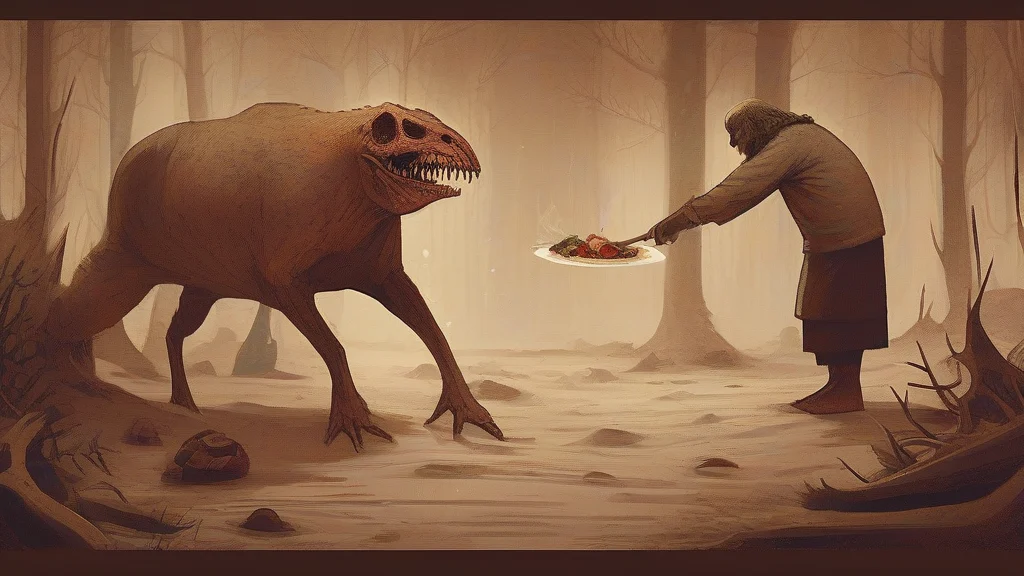
What does anthropophagous mean?
Anthropophagous is a formal adjective meaning man-eating — that is, feeding on human flesh. It describes human groups that practice cannibalism as well as animals or legendary creatures said to prey on people, from sharks to the monstrous Laestrygonians of Greek myth. Derived from Greek roots meaning 'human' and 'to eat,' the word entered English in the seventeenth century through learned Latin usage and remains largely confined to scholarly writing in anthropology, history, zoology, and literary criticism. It is closely related to the noun anthropophagy (the practice of eating human flesh) and to anthropophagi (man-eaters themselves). Because Europeans historically used the label to portray distant peoples as savage, the term can carry connotations of horror and otherness, so careful modern writers often choose the more neutral 'cannibalistic' instead. Its vivid etymology and grim associations nonetheless make it a striking word for describing humanity's most taboo behavior.
adjectiveFeeding on human flesh; relating to or characteristic of man-eating. The term is applied both to humans who practice cannibalism and, in zoology and folklore, to creatures said to devour people.
- (Of a person or group) practicing cannibalism; habitually eating human flesh.
- (Of an animal or creature in folklore or natural history) preying upon or devouring human beings.
"The explorer's journal described the island's anthropophagous tribes with a mixture of horror and fascination."
"Early European accounts often portrayed distant peoples as anthropophagous, though such claims were frequently exaggerated or invented."
"In classical mythology, the anthropophagous Laestrygonians devoured several of Odysseus's crew."
The ancient Greeks had a single word for 'man-eating' — and it survives today in the name of the sarcophagus, which literally meant 'flesh-eating stone.'
Reviewed by Deb Chak, Editor. AI-assisted content curated by RJS Tech Solutions LLP.
Etymology of anthropophagous
Anthropophagous derives from the Greek anthrōpophagos, formed from anthrōpos ('human being') and -phagos ('eating'), the same root that gives English words like esophagus and sarcophagus. The Greek term passed into Latin as anthropophagus and entered English in the early seventeenth century via learned Latin usage, alongside its cognates anthropophagy and anthropophagi. Related forms include the agent nouns anthropophagite and anthropophagist, denoting a person who eats human flesh.
Related word forms
How anthropophagous is actually used
Anthropophagous is a formal, scholarly term, found chiefly in anthropology, history, zoology, and literary criticism rather than everyday speech. It carries strong connotations of horror and otherness, and because it has often been used pejoratively to characterize foreign or 'primitive' peoples, modern writers tend to prefer neutral terms like 'cannibalistic' when describing actual practices.
Easily confused with anthropophagous
Cannibalistic refers to eating members of one's own species, whereas anthropophagous specifically means eating human flesh.
Sarcophagous means flesh-eating in general (as of certain insects), while anthropophagous refers specifically to consuming human flesh.