What does anviling mean?
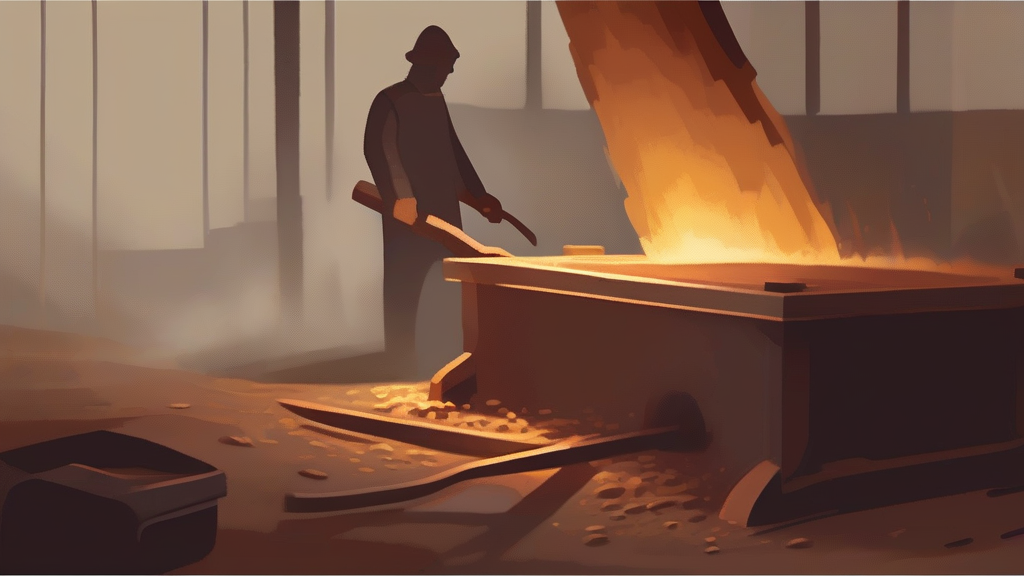
Anviling is the present participle of the uncommon verb 'to anvil', meaning to strike or shape metal by hammering it on an anvil — the heavy iron block that has anchored the blacksmith's trade for centuries. The word belongs almost entirely to the vocabulary of traditional metalworking, appearing in historical, literary, or craft-focused writing rather than everyday speech. When a smith heats a bar of iron until it glows and then beats it against the anvil's face, bending, flattening, or tapering it into a tool, hinge, or horseshoe, that activity can be described as anviling. In modern usage the word is rare: most speakers reach for 'hammering' or 'forging' instead, and even dictionaries treat 'anvil' primarily as a noun. Its value lies in evoking the physical rhythm of pre-industrial craftsmanship — the ring of iron on iron, sparks scattering in a dim workshop. For readers interested in trades, history, or vivid description, anviling offers a precise, tactile term for one of humanity's oldest skills.
verb (present participle of 'anvil')The act of striking or shaping metal on an anvil; the present participle of the rare verb 'to anvil', meaning to work or hammer material upon an anvil.
- Striking or shaping heated metal by hammering it on an anvil (blacksmithing).
"The blacksmith spent the afternoon anviling the red-hot iron into a horseshoe."
"Sparks flew as the smith stood anviling the glowing bar of steel."
"In the old workshop, the sound of anviling rang out from dawn until dusk."
Before factories, nearly every piece of iron in daily life passed through someone's hands while they were anviling it into shape.
Reviewed by Deb Chak, Editor. AI-assisted content curated by RJS Tech Solutions LLP.
Etymology of anviling
The word derives from 'anvil', which comes from Old English 'anfealt' or 'anfilt', inherited through Proto-Germanic and ultimately connected to ancient roots associated with bending or folding metal. The noun 'anvil' has been part of English since the earliest recorded period, reflecting the antiquity of metalworking itself. The verb 'to anvil' arose later as a functional back-formation from the noun, and its participial form 'anviling' remains a rare, specialized usage found chiefly in descriptions of blacksmithing.
Related word forms
How anviling is actually used
Rare and largely confined to descriptions of traditional blacksmithing; most writers simply use 'hammering' or 'forging' instead. The base verb 'anvil' itself is uncommon, so its participial form appears mainly in literary or historical contexts.
Easily confused with anviling
'Anvil' is the heavy iron block on which metal is worked, while 'anviling' is the verbal form describing the action of hammering on one.