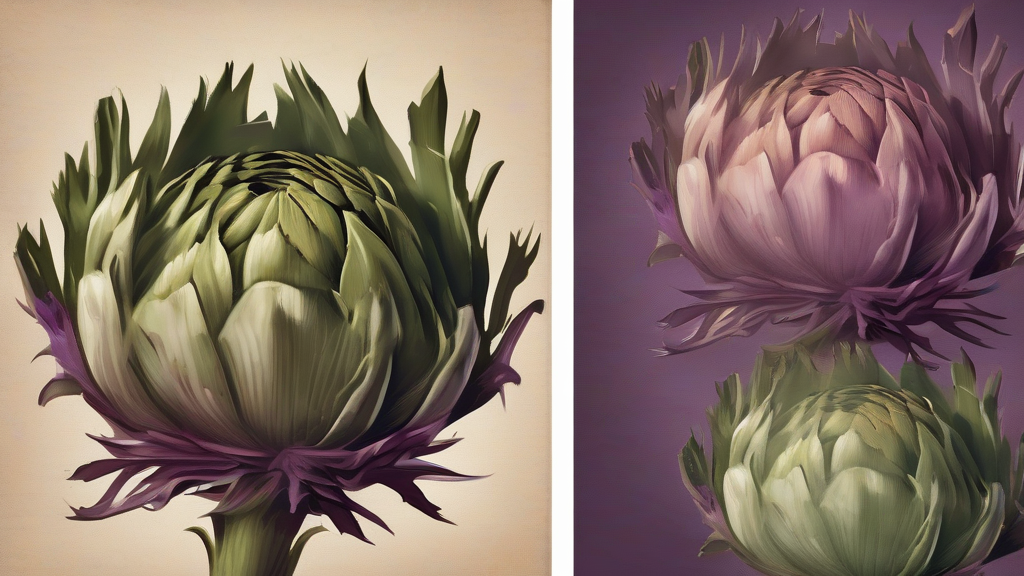
What does artichoke mean?
An artichoke is a thistle-like plant native to the Mediterranean, cultivated since antiquity for its large, edible flower heads, and it also refers to those heads themselves once harvested as a vegetable. The part people eat is actually an unopened bud: its thickened base, called the heart, and its fleshy outer scales are steamed, boiled, roasted, or grilled, often dipped in butter, oil, or sauce. The word functions as a common noun with no stylistic restrictions, appearing freely in recipes, menus, and gardening contexts, and it forms familiar compounds such as "artichoke hearts" and "artichoke dip." A related term, "globe artichoke," distinguishes the true plant from the Jerusalem artichoke, which despite its name is a sunflower grown for its tuber rather than a genuine artichoke. Rich in fiber and prized for its delicate, nutty flavor, the artichoke carries warm connotations of rustic Mediterranean cooking and remains one of the more distinctive vegetables on any plate.
nounA thistle-like Mediterranean plant (Cynara cardunculus var. scolymus) cultivated for its large, fleshy flower head, whose edible base and scales are eaten as a vegetable; also, the unopened flower head itself when used as food.
- The globe artichoke plant, a thistle-like perennial of the Mediterranean region grown for its edible flower head.
- The unopened flower head of this plant, with its fleshy receptacle and scale-like bracts, cooked and eaten as a vegetable.
- Used attributively in names of other plants or foods resembling it, most notably the Jerusalem artichoke (a sunflower tuber) and artichoke hearts (the tender inner base sold canned or jarred).
"She steamed the artichoke for forty minutes and served it with melted garlic butter."
"At the market she chose a firm artichoke with tightly closed leaves and a deep green color."
"The pasta came dressed in a creamy sauce studded with artichoke hearts and lemon zest."
Standard regular plural, used both for multiple plants and for multiple prepared vegetables; also frequent in generic statements about produce.
"Artichokes are in season from early spring through late fall in coastal California."
The artichoke is technically an unopened flower bud — every one you eat was a thistle that never got the chance to bloom.
Reviewed by Deb Chak, Editor. AI-assisted content curated by RJS Tech Solutions LLP.
Etymology of artichoke
The word "artichoke" entered English in the early 16th century by way of Italian "articiocco" (modern "carciofo" reflects a variant form), which itself derives from Arabic "al-kharshūf," meaning the same plant. The English form was further shaped by folk association with the existing words "art" and "choke." Its cognates include Spanish "alcachofa," French "artichaut," and Italian "carciofo," all ultimately tracing back to the same Arabic root, making it one of many food words that entered European languages through Mediterranean trade and cultivation.
How artichoke is actually used
Artichoke is an everyday culinary noun with no marked register. It appears frequently in plural form when referring to produce, and attributively in compounds such as "artichoke heart" and "artichoke dip." In American usage, "globe artichoke" distinguishes the true artichoke from the unrelated Jerusalem artichoke. The word carries pleasant, gourmet connotations, often evoking Mediterranean cuisine.
Easily confused with artichoke
Despite the name, the Jerusalem artichoke is a completely different plant — a sunflower relative eaten for its edible tuber, not a true artichoke at all.