What does autoharp mean?
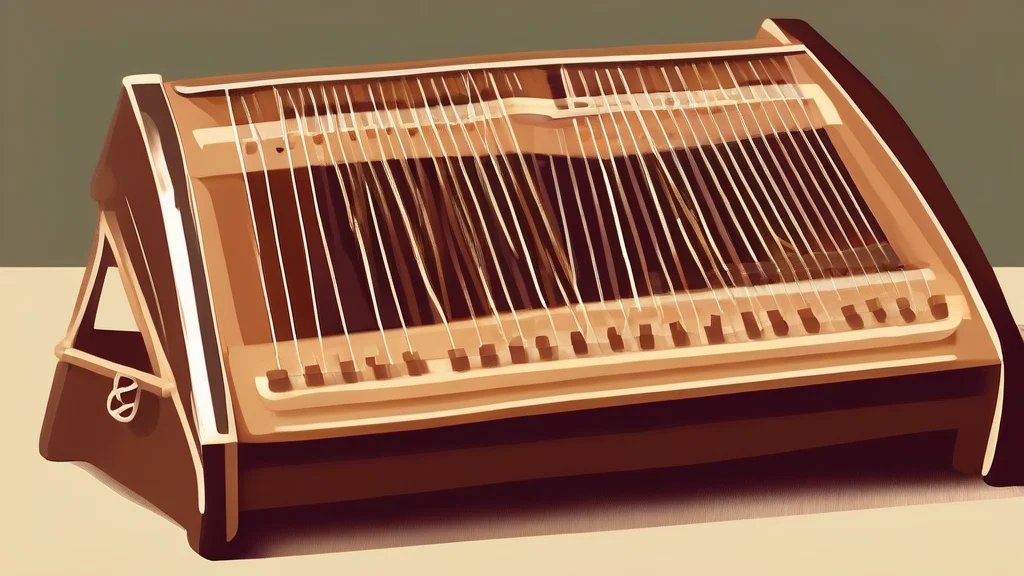
An autoharp is a fretless stringed instrument belonging to the zither family, characterized by a flat wooden body across which numerous open strings are stretched. Its defining feature is a set of spring-loaded chord bars that, when depressed, damp every string except those tuned to the notes of a particular chord. This mechanism allows even beginners to produce full harmonic accompaniment by simply strumming across the strings, which explains the instrument's enduring popularity among amateur musicians, teachers, and folk performers. Invented in Germany in the late nineteenth century and subsequently developed in the United States, the autoharp became closely identified with American folk, country, and old-time music, most famously through Maybelle Carter of the Carter Family. Typically equipped with twelve, fifteen, or twenty-one chord bars, it produces a warm, shimmering, gently rhythmic sound that suits vocal accompaniment particularly well. Though modest in technical demands, the autoharp occupies a distinctive and affectionate place in the history of vernacular American music.
nounA stringed musical instrument of the zither family, consisting of a soundboard with strings and a series of chord bars that, when pressed, damp all strings except those belonging to the selected chord. It is played by strumming or plucking while operating the chord bars.
- A stringed instrument with a rectangular soundboard and chord bars used to select chords while strumming, popular in American folk, country, and old-time music.
"She accompanied her folk songs on an autoharp, pressing the chord bars as she strummed."
"Maybelle Carter of the Carter Family made the autoharp central to American country music."
"He picked up the autoharp at the folk festival and strummed along to the ballad."
Regular plural formation; used when referring to multiple instruments or models.
"The music shop stocked several autoharps in different sizes."
The autoharp was patented in 1885 — but its inventor, Karl August Gütter, didn't even play it well enough to demonstrate it, so his business partner took over the job.
Reviewed by Deb Chak, Editor. AI-assisted content curated by RJS Tech Solutions LLP.
Etymology of autoharp
The word 'autoharp' combines the Greek-derived prefix 'auto-' (from 'autos', meaning self) with 'harp', reflecting the instrument's self-playing ease: chord bars do much of the harmonic work automatically. The instrument itself was designed in Germany in the late nineteenth century — a chorded zither was patented by Karl August Gütter in 1885 under the name 'autoharp' — and commercialized largely through the German firm Zimmermann before spreading to America. The name thus pairs a classical Greek root shared with words like 'automatic' and 'automaton' with the older English word 'harp'.
How autoharp is actually used
The autoharp is strongly associated with American folk and country traditions, especially Appalachian music and the Carter Family. It is sometimes loosely called a 'chorded zither,' though 'autoharp' originally referred specifically to instruments based on Gütter's patented design. Trademark issues led some manufacturers to use alternative names, but 'autoharp' remains the generic term in common usage.
Easily confused with autoharp
An autoharp is a specific type of chorded zither with mechanical chord bars; a plain zither has no such mechanism.
A harp is played by plucking individual strings directly with the fingers and has no chord bars, unlike the autoharp's damped-strumming design.