What does banderilla mean?
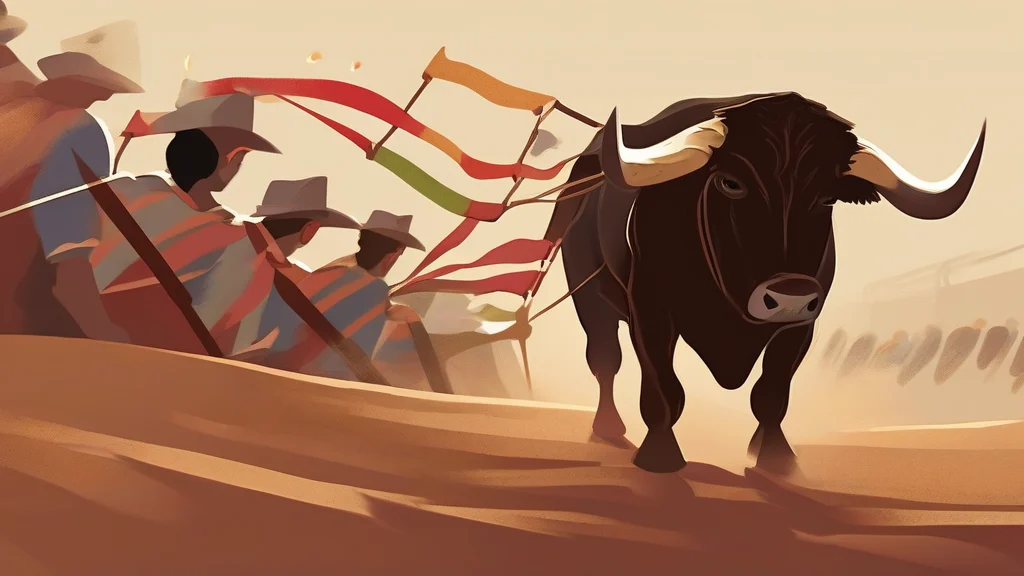
A banderilla is a slender, barbed dart decorated with brightly colored paper fringes, used in Spanish-style bullfighting. During the second act of a corrida, assistants known as banderilleros plunge pairs of banderillas into the upper back and shoulders of the bull to weaken its neck muscles and heighten the drama of the performance. The word comes from Spanish, where it is the diminutive of banda, meaning a sash or ribbon, so it literally suggests a small banner — a fitting name for a weapon adorned with fluttering streamers. Although firmly tied to the world of tauromachy, banderilla occasionally appears figuratively to describe anything sharp and ornamental that is stuck into something else. Because bullfighting is controversial, references to banderillas often carry connotations of spectacle, tradition, and cruelty alike, making the word culturally loaded as well as precise.
nounA decorated barbed dart, typically with a colorful paper streamer at one end, that a bullfighter thrusts into the shoulders and neck of a bull during the second stage of a corrida.
- A decorated barbed dart planted in the bull during the second act of a Spanish-style bullfight.
"The matador's assistant stepped forward and drove a pair of banderillas into the charging bull's shoulders."
"With each pass, the banderillero planted the banderillas deep into the bull's muscular hump."
"In the museum display case lay a faded pair of banderillas, their paper fringes still bright after decades."
The standard plural simply adds -s, following normal English pluralization of the loanword; it is far more common than any attempt to retain a Latinate plural ending.
"The banderillero carried two pairs of banderillas under his arm as he entered the ring."
Named after a sash — the banderilla is literally a little 'little flag', a barbed dart dressed up in fluttering colored paper for the bullring.
Reviewed by Deb Chak, Editor. AI-assisted content curated by RJS Tech Solutions LLP.
Etymology of banderilla
Banderilla entered English from Spanish, where it is formed as a diminutive of banda, meaning a sash, ribbon, or strip of cloth. Banda itself traces back through French bande to Germanic origins, the same source that gives English words such as band, banner, and bandolier. The word was borrowed in the context of descriptions of the Spanish corrida, likely by the nineteenth century, when bullfighting drew wide attention across Europe and the Americas.
How banderilla is actually used
The word belongs chiefly to the specialized vocabulary of bullfighting (corrida) and is most often encountered in writing about Spanish or Latin American culture; it is a loanword from Spanish and is sometimes left unitalicized as a fully naturalized English term.
Easily confused with banderilla
A banderole is a small forked flag or streamer used as an emblem or decoration, whereas a banderilla is a physical barbed dart used in bullfighting.