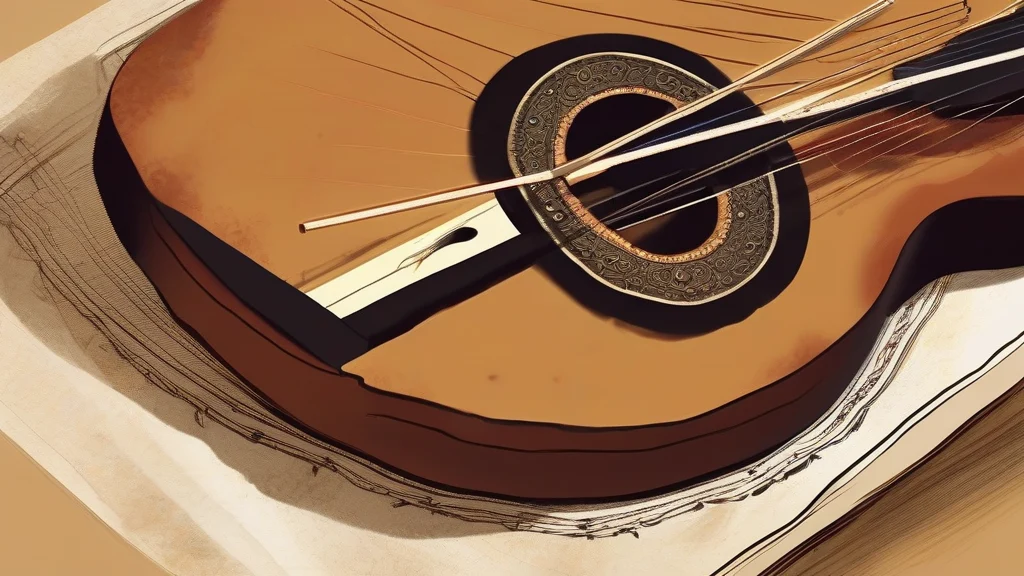
What does bandore mean?
The bandore is a plucked stringed instrument that flourished in England during the late sixteenth and seventeenth centuries, belonging to the broad family that includes the lute, cittern, and guitar. Typically strung with six or seven courses of strings and possessing a flat back rather than the rounded body of a lute, it was played with the fingers or a plectrum and valued for its bright, resonant tone. Its very name reflects a tangled history: it descends from 'pandore', itself tracing back through medieval Europe to the ancient Greek pandoura, a long-necked lute, making the bandore a linguistic cousin of the modern mandolin. In Elizabethan and Jacobean England the instrument appeared in domestic music-making, taverns, and court entertainments alike, often mentioned alongside the orpharion and cittern as alternatives to the lute. Although it fell out of use by the eighteenth century and survives today only in historical performance and scholarship, the bandore remains a useful term for readers of early modern literature and students of organology, offering a window into the rich instrumental culture of the Renaissance.
nounA bandore is a large plucked stringed instrument of the 16th and 17th centuries, similar to a lute or cittern, typically having six or seven courses of strings and played with the fingers or a plectrum.
- A plucked stringed instrument of the 16th–17th centuries, of the lute/cittern family, with a flat back and multiple courses of strings.
- (Rare, historical) The name was also loosely applied to related instruments such as the pandore or orpharion.
"The minstrel tuned his bandore before beginning the evening's entertainment."
"The court musician set aside his lute and took up the bandore for the livelier dance tunes."
"In Shakespeare's England, the bandore was a familiar sight at tavern gatherings, its bright strings carrying above the chatter."
Standard plural formation applies; the plural appears mainly in historical or museum contexts describing collections of instruments.
"The museum's collection included two surviving bandores from the Elizabethan era."
The word 'bandore' is really just 'pandore' wearing an English accent — the instrument arrived in Tudor England and its name got bent along the way.
Reviewed by Deb Chak, Editor. AI-assisted content curated by RJS Tech Solutions LLP.
Etymology of bandore
The word 'bandore' derives from 'pandore' (also spelled pandora), the name of a Renaissance stringed instrument, with the initial element altered under English usage — likely influenced by 'band' or by association with other instruments. The pandore itself traces back through medieval European forms to the Greek 'pandoura', an ancient long-necked lute, making 'bandore' a distant relative of the modern mandolin family (via 'mandore') and of instruments such as the Spanish bandurria. The instrument and its name were current in English from the mid-sixteenth century, and variant spellings such as 'bandora' appear in period sources.
How bandore is actually used
The word is now almost entirely historical or musicological, appearing mainly in discussions of Renaissance and early Baroque music. It carries no informal register and would sound archaic outside scholarly contexts. Spellings varied historically (bandore, pandore, pandora), which can complicate references in older sources.
Easily confused with bandore
A bandura is a Ukrainian plucked-string folk instrument with many strings, whereas the bandore is an early modern European bass lute-family instrument.
A pandore is a closely related but distinct Renaissance stringed instrument; 'bandore' is essentially the anglicized form of the same name applied to the English instrument.