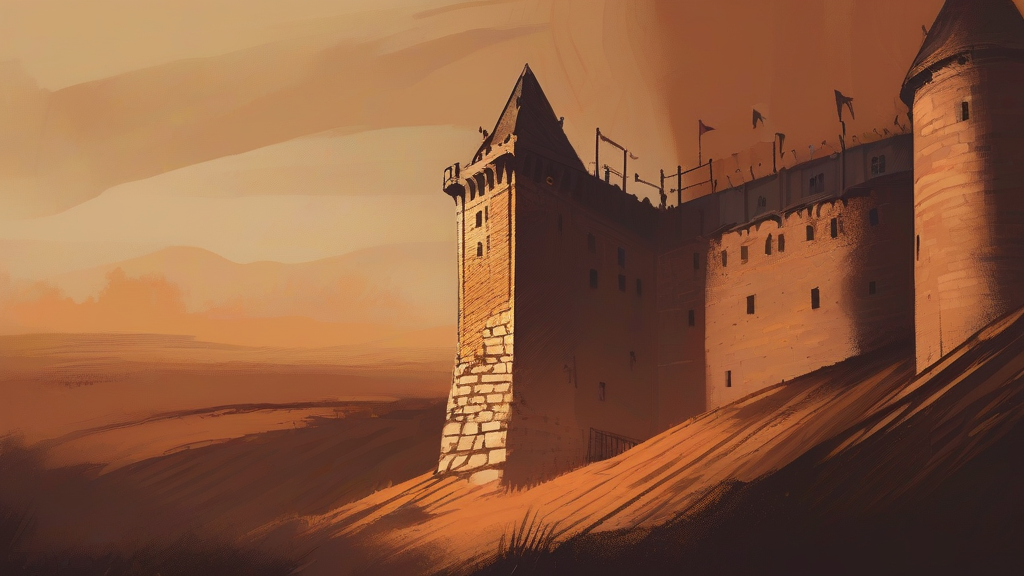
What does bastile mean?
A bastile is a fortress or stronghold, and by extension a prison — a place where people are confined behind heavy walls. The word is best known through its capitalized form, the Bastile (more commonly spelled Bastille), the medieval Parisian fortress used as a royal state prison whose storming on 14 July 1789 became the defining act of the French Revolution. Used generically in English since at least the seventeenth century, "bastile" can describe any imposing fortified structure, or figuratively, any oppressive institution that confines people — a harsh school, a forbidding hospital, or a tyrannical regime might all be called a bastile. The spelling "bastile" is an anglicized variant; modern writers overwhelmingly prefer "bastille," so encountering "bastile" today usually signals historical or literary text. The word carries strong connotations of oppression, despotism, and eventual liberation, which is precisely why it remains evocative: few words so compactly capture both the machinery of imprisonment and the dramatic moment of its overthrow.
nounA fortress or stronghold; specifically, a place of confinement or imprisonment, most famously referring to the Bastille, the medieval French state prison stormed in 1789.
- A fortress or fortified stronghold.
- A prison or place of detention, especially by association with the Bastille of Paris.
"The old citadel loomed over the harbor like some ancient bastile."
"Rebels massed outside the bastile, demanding the release of its prisoners."
"The writer described his boarding school as a bastile where boys were shut away from the world."
Standard plural; rarely encountered because the word itself is uncommon and typically refers to a single famous fortress.
"The countryside was dotted with crumbling bastiles from centuries past."
When revolutionaries stormed the Bastile in 1789, they found only seven prisoners inside — but its fall still toppled a kingdom's image.
Reviewed by Deb Chak, Editor. AI-assisted content curated by RJS Tech Solutions LLP.
Etymology of bastile
Bastile comes from French, ultimately from Old French "bastir," meaning "to build" — the same root that gives us "bastion" and "bastide." It entered English in the early modern period as an anglicized spelling of "bastille." Its enduring fame rests on the Bastille Saint-Antoine in Paris, built as a fortress in the fourteenth century and later converted into a state prison, whose capture by revolutionaries on 14 July 1789 made the word a lasting symbol of tyranny overthrown.
How bastile is actually used
The spelling "bastile" is now rare and largely historical or literary; "bastille" is the standard form. When capitalized as "the Bastile" it refers to the Parisian fortress-prison whose storming on 14 July 1789 became a symbol of the French Revolution. Lowercase uses treat it as a general word for any grim fortress or prison, often figuratively.
Easily confused with bastile
"Bastille" is the standard spelling of both the French word and the famous Parisian prison, while "bastile" is an anglicized variant spelling of the same word.