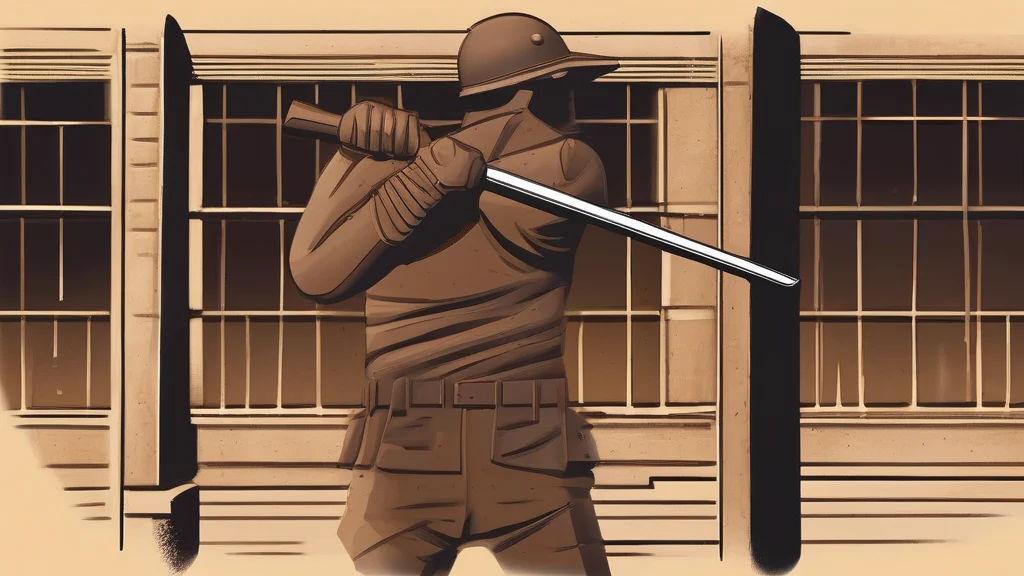
What does batoned mean?
"Batoned" is the past tense and past participle of the verb "to baton," which means to strike someone or something with a baton — most commonly the short, heavy stick carried by police officers, known in British English as a truncheon. The word appears almost exclusively in contexts involving force: news reports of protests, historical accounts of riots, and descriptions of policing tactics frequently state that demonstrators were "batoned" by officers. Because the action it describes is inherently violent, the term carries strongly negative connotations and is rarely used outside accounts of physical confrontation. It is far more common in British journalism than in American writing, where related terms like "clubbed" may appear instead. The verb derives simply from the noun "baton," illustrating English's habit of converting object names into verbs. Writers use it when they want a concise, vivid way to describe a blow delivered with such an implement, particularly in passive constructions such as "the marchers were batoned."
verbBatoned is the past tense and past participle of the verb "baton," meaning to strike or beat someone or something with a baton, typically a policeman's truncheon.
- To strike or beat someone with a baton (past tense/past participle).
"The protesters were batoned by riot police as they tried to cross the barricade."
"Demonstrators claimed they were batoned without warning as the police line advanced."
"The horse had been batoned on the flank to keep it moving through the narrow lane."
When police 'baton' a crowd, English borrows a weapon's name and turns it into a verb — a rare case of an object of force becoming the act itself.
Reviewed by Deb Chak, Editor. AI-assisted content curated by RJS Tech Solutions LLP.
Etymology of batoned
The noun "baton" entered English from French in the 16th century, ultimately deriving from Late Latin "bastum," a staff or stick. The verb "to baton," meaning to strike with such a stick, formed by straightforward conversion of the noun into a verb, a productive pattern in English; "batoned" is its past-tense form. Cognates of the noun include French "bâton" and Italian "bastone," both meaning a stout stick.
Related word forms
How batoned is actually used
The verb "baton" is relatively rare and chiefly appears in journalistic accounts of policing and crowd control, especially in British reporting. It is more common in passive constructions ("was batoned") than in active ones. The spelling "batonned" occasionally appears but "batoned" is standard.
Easily confused with batoned
"Buttoned" refers to fastening with buttons, while "batoned" means struck or beaten with a baton.