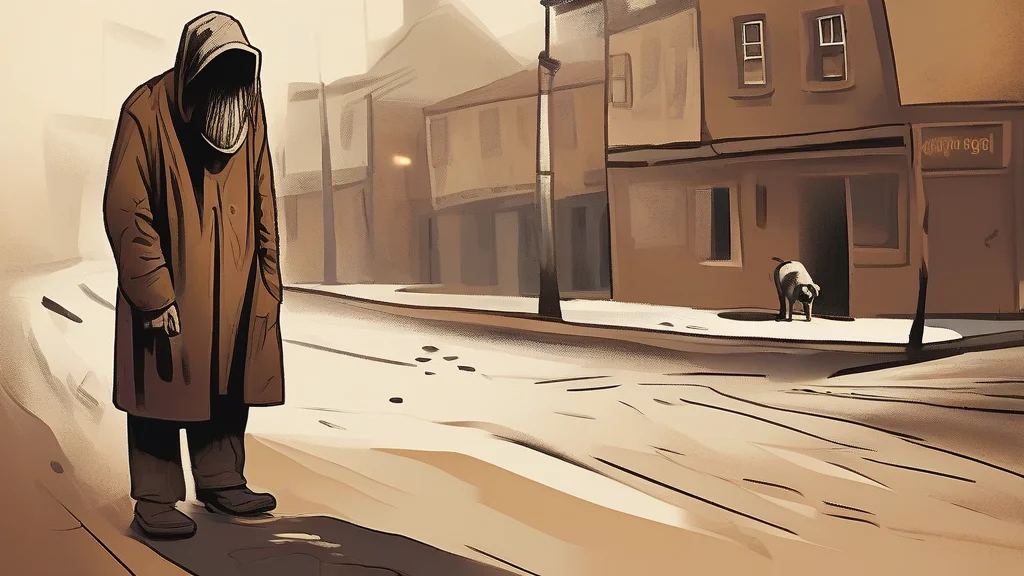
What does beggar mean?
A beggar is a person who is extremely poor and who lives, wholly or partly, by soliciting money or food from others. The word carries strong connotations of destitution and dependence, and in everyday speech it can range from compassionate description to dismissive stereotype, so writers should use it with sensitivity. Beyond its noun sense, 'beggar' functions as a verb meaning to impoverish completely or, figuratively, to overwhelm something beyond expression — most famously in the fixed phrases 'beggar belief' and 'beggar description,' which describe things so extraordinary they cannot credibly be put into words. The word also survives in idioms such as 'beggars can't be choosers,' reminding us that those with no alternatives must accept what they are offered. Derived forms include the adjective 'beggarly,' meaning pitifully small or mean. With roots stretching back to medieval Europe and a figurative reach into modern rhetoric, 'beggar' remains a compact, expressive word at once social, moral, and literary.
A person who begs, especially one who is extremely poor and depends on the charity of strangers for food or money.
"In the old city, a beggar crouched beneath the archway, murmuring thanks to each passerby."
Can carry pejorative connotations; in informal British usage it may also affectionately describe a troublesome or unlucky person, as in 'you lucky beggar.'
To reduce someone to extreme poverty; figuratively, to surpass or defy all attempts at description or belief.
"The sheer scale of the cathedral's interior beggars description."
Most common today in the fixed phrases 'beggar belief' and 'beggar description.'
Regular plural: add -s. Commonly used generically in proverbs and generalizations about the poor.
"The city's streets were lined with beggars seeking shelter from the winter cold."
"Beggar" likely traces back to Beghard — medieval lay religious orders who begged for their living — making the word's origin surprisingly pious rather than pitiful.
Reviewed by Deb Chak, Editor. AI-assisted content curated by RJS Tech Solutions LLP.
Etymology of beggar
The noun 'beggar' first appeared in English in the Middle Ages, and although its exact origin is debated, the most widely accepted account links it to medieval religious mendicants. It is often connected to the Beghards and Beguines — lay religious brotherhoods of the Low Countries who lived without personal property — and to Old French 'begard.' The verb sense developed from the noun, first meaning to reduce to beggary and later, figuratively, to exhaust or surpass all resources of description. Cognates appear across European languages, reflecting the pan-European phenomenon of mendicant religious life.
Related word forms
How beggar is actually used
As a verb meaning 'to exhaust the resources of' or 'to exceed description,' 'beggar' appears mainly in fixed expressions like 'beggar belief' and 'beggar description.' In some regions, especially Britain, calling someone a 'beggar' can be an affectionate or mildly exasperating term for a mischievous person ('you cheeky little beggar'), so tone matters. The adjective 'beggarly' means paltry or miserably inadequate.
Easily confused with beggar
Not commonly confused; a closer confusion is 'begger', an obsolete spelling of beggar that should not be used in modern writing.