What does beguine mean?
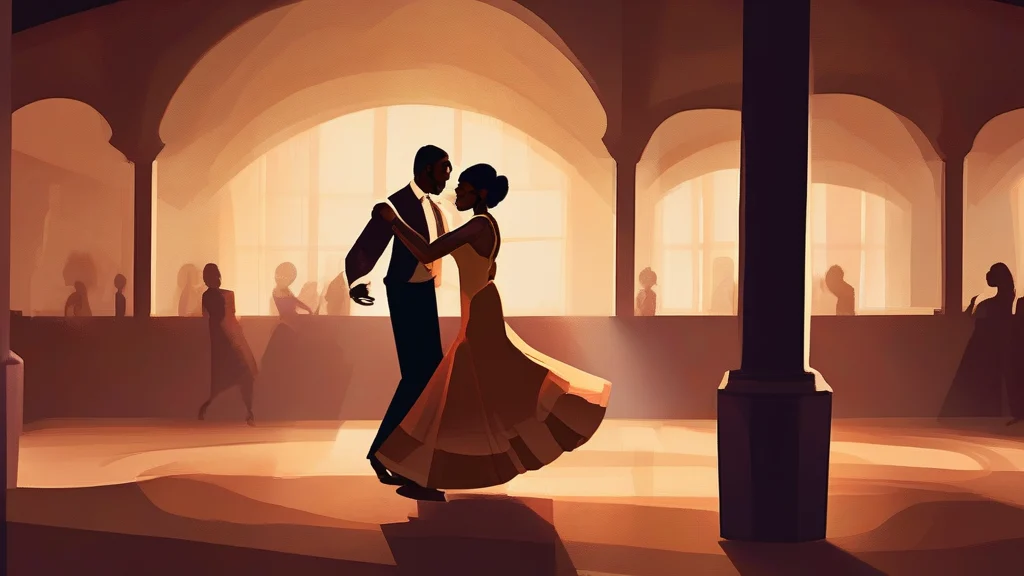
A beguine is primarily a slow, sinuous ballroom dance of West Indian origin, akin to a gentle rumba or foxtrot, along with the music composed for it. The word entered wide English usage through Cole Porter's 1935 standard "Begin the Beguine," which made the term synonymous with tropical romance and big-band elegance. Less commonly, a beguine denotes a member of the Beguines, a movement of devout laywomen who lived in semi-monastic communities called beguinages across the Low Countries and elsewhere in northern Europe from the twelfth century onward, without taking permanent vows. In modern writing the dance sense predominates and evokes vintage glamour, while the religious sense is confined mainly to historical scholarship. The plural is beguines, and the word should not be confused with the verb "begin."
A ballroom dance of West Indian origin, similar to a slow rumba or foxtrot, or the music for it.
"They swayed across the floor to a beguine played by the hotel band."
Almost always encountered today in this musical/dance sense, especially in reference to mid-twentieth-century popular songs.
A member of a lay Christian sisterhood, the Beguines, that flourished in the Low Countries and parts of northern Europe from the Middle Ages onward.
"As a beguine, she took no vows but devoted her life to prayer and caring for the poor."
Often capitalized ("Beguine") when referring to an individual member; the collective movement is "the Beguines" and their dwelling was a beguinage.
Standard English plural; used both for multiple dances/pieces of music and for multiple members of the sisterhood (often capitalized as "Beguines" in the latter case).
"The repertoire included several beguines alongside the usual tangos."
The dance got its name in pop culture thanks to Cole Porter's "Begin the Beguine" — a song so famously intricate that musicians joke about its length.
Reviewed by Deb Chak, Editor. AI-assisted content curated by RJS Tech Solutions LLP.
Etymology of beguine
The dance name "beguine" comes ultimately from the French "béguine," referring to the Beguines, the medieval lay sisters of the Low Countries; how the dance acquired this name is not firmly established, though it spread into English via Caribbean and Latin American music in the early twentieth century. The word "beguine" itself first appears in English in medieval contexts referring to the religious sisters. Its ultimate origin is uncertain; one traditional account derives it from Lambert le Bègue ("the Stammerer"), a priest associated with early supporters of the movement, while others propose Old Frankish roots. A related survival is "beguinage," the term for a Beguine community house.
How beguine is actually used
The dance sense is by far the more common today, largely through its association with popular songs of the 1930s and 1940s; it carries a nostalgic, mid-century glamour. The religious sense is historical and appears mainly in scholarly or ecclesiastical writing, where it is often capitalized as "Beguin(e)" when referring to an individual member of the order.
Easily confused with beguine
"Begin" is the common verb meaning to start something, while "beguine" is a noun naming either a dance or a member of a medieval lay sisterhood — they share letters but nothing else.