What does foxtrot mean?
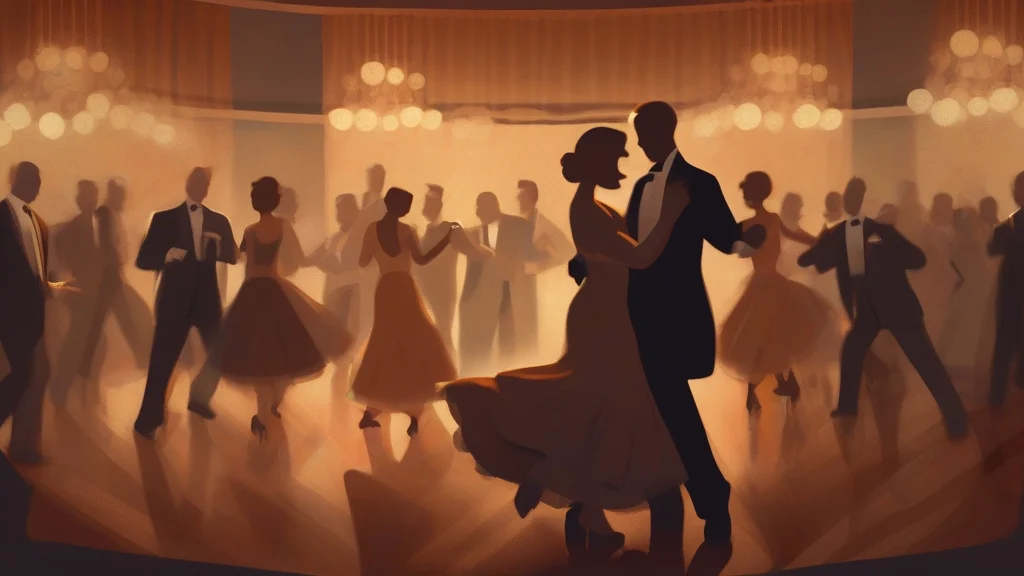
The foxtrot is a classic ballroom dance that emerged in the United States in the early twentieth century, generally credited to vaudeville performer Harry Fox around 1914. Danced in 4/4 time to moderate-tempo jazz and big-band music, it alternates slow and quick steps in a smooth, gliding style that made it enormously popular during the dance crazes of the 1910s through the big-band era. Today it remains a cornerstone of ballroom and competitive dancing alongside the waltz, tango, and quickstep, prized for its graceful, unhurried elegance. The word also has a completely separate life as the designated code word for the letter 'F' in the NATO phonetic alphabet, where it appears routinely in military and aviation communication. Whether on the dance floor or over the radio, 'foxtrot' is a familiar and culturally embedded English word with a distinctive double identity.
A smooth American ballroom dance in 4/4 time, characterized by alternating slow and quick steps and a flowing, gliding movement across the floor.
"The finalists chose a slow foxtrot for their showcase performance."
In Dancesport terminology, the slower variant is often distinguished as the 'slow foxtrot', while a faster version evolved into the separate quickstep.
In the NATO phonetic alphabet, the standard code word representing the letter 'F'.
"The controller read back the flight identifier using 'Foxtrot' for the initial letter."
The plural refers either to multiple instances of the dance or, less commonly, multiple occurrences of the code word.
"The evening's programme included two foxtrots and a rumba."
The foxtrot was reportedly popularized by vaudeville performer Harry Fox around 1914 — a dance named after a man whose act happened to include a jaunty trotting step.
Reviewed by Deb Chak, Editor. AI-assisted content curated by RJS Tech Solutions LLP.
Etymology of foxtrot
The foxtrot takes its name directly from the animal: the combination of 'fox' and 'trot', reflecting the trotting character of its basic steps. It arose in the United States in the early twentieth century — commonly dated to around 1912–1914 — and is widely associated with the vaudeville comedian Harry Fox, whose trotting step to ragtime music helped launch the craze, though several dancers contributed to shaping the dance itself. Because it is a modern compound of native English words, it shares roots simply with other compounds built on 'fox', such as foxhound and foxhole.
How foxtrot is actually used
The word is most strongly associated with ballroom dancing, where the foxtrot remains a staple of both social dancing and competitive Dancesport. In military and aviation contexts, its use as a NATO alphabet code word is entirely standard and carries no connection to dancing. The spelling is conventionally written solid ('foxtrot') rather than hyphenated ('fox-trot'), though older texts may hyphenate it.
Easily confused with foxtrot
'Fox trot' also names a smooth four-beat gait of certain horse breeds such as the Missouri Fox Trotter, which is unrelated to the ballroom dance.