
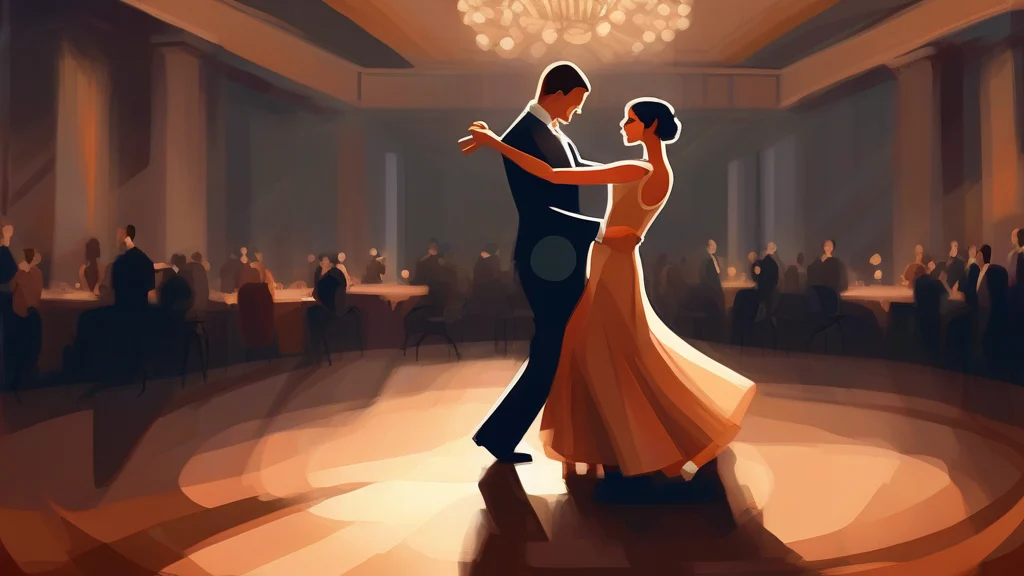
What does waltz mean?
The waltz is a couple's dance in triple time, with a strong first beat and a graceful turning pattern. It is closely associated with European ballroom dancing and can refer to several styles, including the sweeping Viennese waltz. As a verb, “to waltz” originally means to dance this dance, but it can also describe moving or proceeding lightly and casually: someone may “waltz into” a room, or a person may “waltz around” without a particular purpose. The word carries a generally elegant and nostalgic tone when referring to the dance, while the figurative verb often conveys ease, confidence, or nonchalance. It is useful because it combines a precise cultural reference with a flexible, vivid idiom. A waltz can be formally performed in a ballroom or ballroom-style event, but the verb is common in informal speech and writing as well.
A dance in triple time, usually performed by couples and characterized by a strong first beat and a turning pattern.
"The orchestra began playing a waltz, and the dancers moved onto the floor."
The word is often used attributively, as in “Viennese waltz” or “waltz music.”
To dance a waltz; to move or proceed lightly, casually, or confidently.
"She waltzed into the room as though she owned the place."
Figurative uses such as “waltz into” and “waltz around” are idiomatic and often imply relaxed, unhurried movement.
The standard plural is “waltzes,” with the final -s pronounced /z/.
"The band played three waltzes during the evening."
The waltz gets its name from the German word Walzer, which literally means “roller,” recalling the dance's characteristic turning movement.
Reviewed by Deb Chak, Editor. AI-assisted content curated by RJS Tech Solutions LLP.
Where does waltz come from?
English borrowed the word from German Walzer, meaning a dance in which partners turn or roll. German Walzer was formed from walzen, “to roll” or “to turn,” and the dance developed from earlier German turning dances before becoming a prominent ballroom form in the early 19th century. The underlying Germanic word is related to forms connected with the Latin root volv- “to turn,” reflected in cognates such as volta, volume, and revolution.
Related word forms
How waltz is actually used
As a verb, “waltz” can suggest moving or entering with relaxed confidence, and “waltz around” often means to wander or spend time casually. The dance is familiar in British and American English, while “Viennese waltz” specifically refers to the faster, sweeping ballroom style.
Easily confused with waltz
A waltz is a dance, while a volt is a unit of electric potential or a sudden movement or turn.