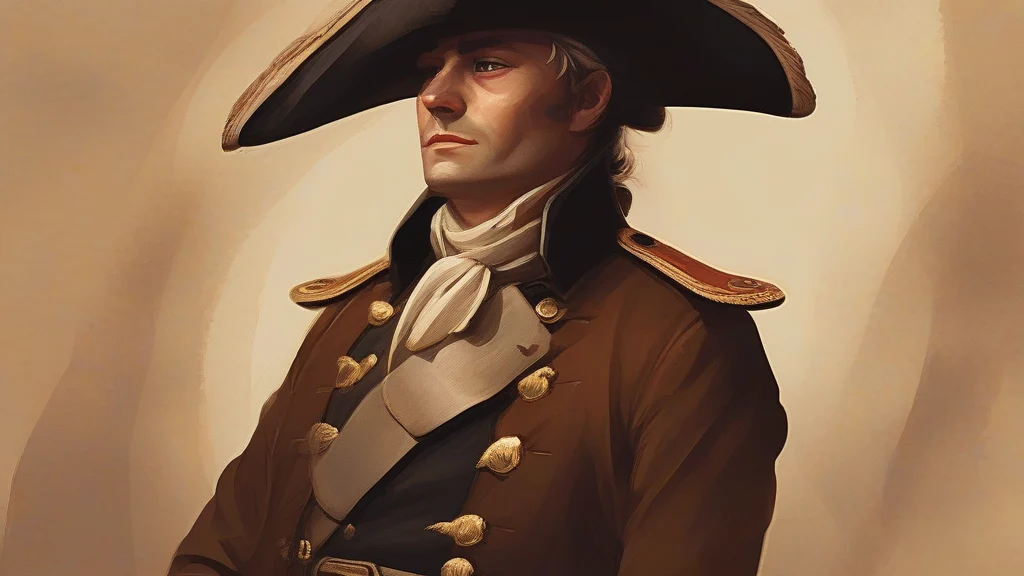
What does bicorne mean?
A bicorne is a hat whose brim is turned up to form two points or horns, most famously associated with European military and naval officers of the late eighteenth and early nineteenth centuries. Worn either fore-and-aft — the style immortalised by Napoleon Bonaparte — or side-to-side, it replaced the earlier three-cornered tricorn as the standard officer's headwear. Beyond its historical sense, 'bicorne' can describe anything shaped like or bearing two horns, a usage borrowed from Latin bi- ('two') and cornu ('horn'). Today the word survives mainly in history books, museums, portraiture, and re-enactment circles, where it serves as a compact shorthand for an entire era of military dress. Its enduring visual association with Napoleon gives it a recognisability that few other items of obsolete clothing enjoy, making it a useful term for anyone writing about the Regency or Napoleonic periods.
A two-cornered hat, especially the military or naval hat of the late 18th and early 19th centuries, worn with the brim cocked up to form two points.
"The museum displayed Wellington's bicorne alongside his campaign uniform."
Almost always encountered in historical or costuming contexts.
Having two horns or horn-like projections.
"The specimen showed a distinctly bicorne outline when viewed under magnification."
Rare and largely confined to technical or descriptive writing.
The plural follows standard English noun inflection; note that some sources treat 'bicorne' as invariant when referring to the hat collectively, but the regular plural is well attested.
"Both generals wore black bicorners at the review."
Napoleon's signature black bicorne wasn't just fashion — he wore it sideways-on so his troops could spot him instantly across a battlefield.
Reviewed by Deb Chak, Editor. AI-assisted content curated by RJS Tech Solutions LLP.
Etymology of bicorne
Bicorne derives from French bicorne, formed from Latin bi- ('two') and cornu ('horn'), literally 'two-horned.' It shares this root with words such as unicorn ('one horn') and Capricorn ('horned goat'). The term entered English in the early nineteenth century, when the two-cornered military hat became widespread across European armies and navies.
Related word forms
How bicorne is actually used
The word appears chiefly in historical, military, and costume contexts; outside discussions of Napoleonic-era dress it is rare. The adjectival sense ('two-horned') is uncommon and mostly technical.
Easily confused with bicorne
A tricorn has three corners or points on its brim, whereas a bicorne has only two.
'Bicorn' is essentially the same word used as an adjective meaning 'two-horned,' while 'bicorne' most commonly refers to the noun denoting the two-cornered hat.