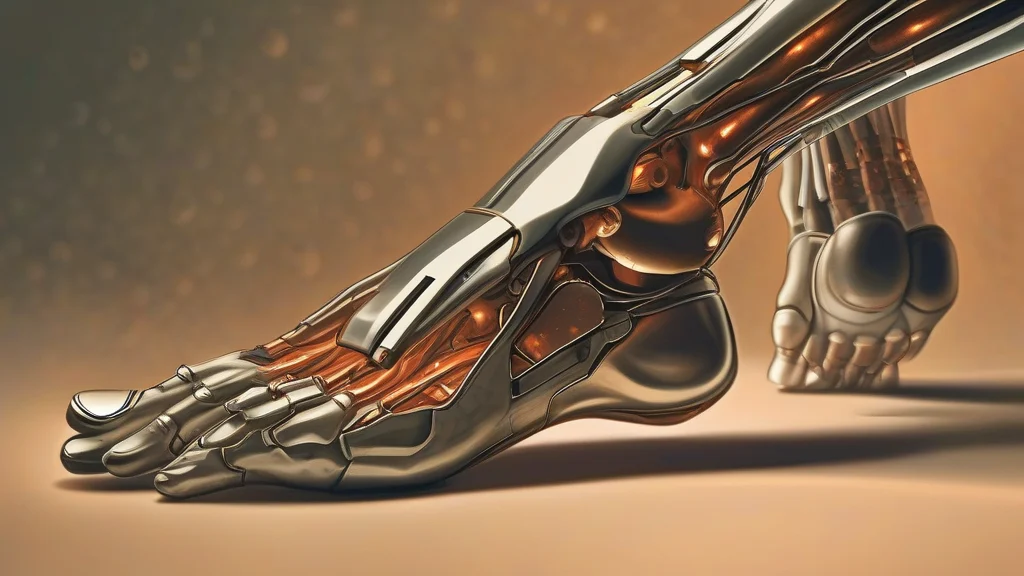
What does bionic mean?
Bionic is an adjective describing artificial, typically electromechanical devices that replace or enhance parts of a living body — most famously bionic limbs, ears, and eyes — as well as technologies and designs inspired by how living organisms work. The word derives from Greek bios, meaning life, combined with a suffix echoing electronics, and it entered English in the mid-twentieth century alongside the rise of cybernetics. In its dominant modern sense, bionic signals the fusion of human biology with engineered hardware, usually with optimistic, forward-looking overtones: a bionic arm is not merely a prosthesis but one that restores or even surpasses normal function through sensors and motors. Informally, the word is used humorously to describe someone remarkably fast, strong, or capable, as though upgraded beyond ordinary human limits. Related terms include bionics, the scientific discipline of copying nature's mechanisms, and bionically, its adverbial form. The word remains vivid and culturally resonant thanks to decades of science fiction.
adjectiveHaving or involving artificial body parts, especially electronic or mechanical devices that enhance or replace natural biological functions; more broadly, using technology to imitate or augment living systems.
- (Of a person or body part) having artificial, typically electromechanical replacements for biological limbs or organs.
- (Of technology or design) modeled on, or applying principles derived from, living systems; relating to the science of bionics.
- (Informal, humorous) superhumanly strong, fast, or capable, as if equipped with such augmentations.
"After the accident, she was fitted with a bionic arm that responds to nerve signals."
"Advances in neural interfaces have made the bionic hand far more responsive than earlier prosthetics."
"Engineers studying gecko feet are applying bionic design principles to create new adhesive materials."
Coined in the late 1950s from Greek 'bios' (life) plus a nod to electronics, 'bionic' gave us both a real science — bionics — and pop culture's Six Million Dollar Man.
Reviewed by Deb Chak, Editor. AI-assisted content curated by RJS Tech Solutions LLP.
Etymology of bionic
Bionic was coined in the late 1950s, blending Greek bios ('life') with the ending of words like electronic to name the then-emerging study of engineering systems modeled on biology. It gained wide currency in the 1970s through popular culture, notably television portrayals of humans given superhuman artificial parts. Cognates sharing the root bios include biology, antibiotic, and symbiosis.
Related word forms
How bionic is actually used
Register is neutral in technical contexts but often playful or hyperbolic in informal use ('bionic hearing'). The word carries broadly positive, futuristic connotations. In British English it is equally common; no significant regional variation. Avoid overusing it as a loose synonym for 'robotic' — bionic specifically implies integration with or imitation of living systems.
Easily confused with bionic
The adjective describes augmented organisms or systems, while the noun 'bionics' names the scientific field that studies and builds them.
'Bionic' refers to mechanical/electronic augmentation of living bodies, whereas 'biochemical' concerns the chemical processes within organisms.