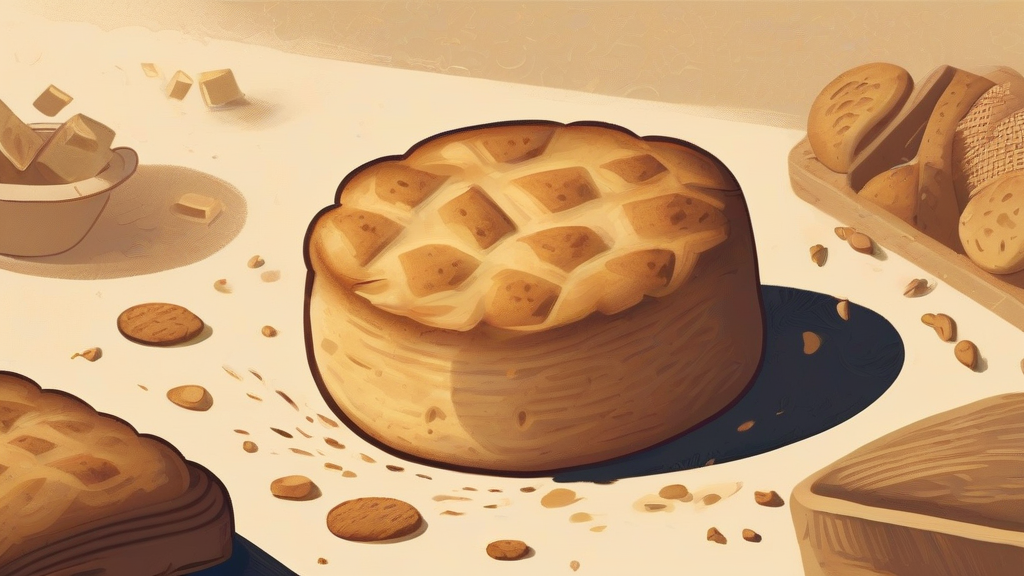
What does biscuit mean?
Biscuit is one of those deceptively simple words whose meaning depends entirely on where you are standing. In British English, a biscuit is a small, flat, sweetly flavored baked good — crisp or crumbly rather than soft — typically enjoyed alongside a cup of tea, and it corresponds exactly to what Americans call a cookie. In North America, by contrast, a biscuit is a small, round, tender quick bread raised with baking powder, prized for its flaky layers and commonly paired with butter, honey, or sausage gravy at breakfast. Beyond the kitchen, the word has technical lives too: potters use 'biscuit' (or 'bisque') for clay that has been fired once but not glazed, and decorators borrow 'biscuit' as the name of the pale beige tone of such ware. The word itself carries a story of survival: it comes from the Latin bis coctus, meaning twice-cooked, because early biscuits were baked twice to remove moisture and endure long sea voyages. That history of hardtack rations lingers in phrases like 'take the biscuit,' a British idiom meaning to surpass all others in boldness or absurdity.
A small flat baked good — sweet and crisp in British usage, or a soft quick bread in North American usage.
"She offered us tea and a plate of biscuits."
Meaning varies sharply by region: British = American 'cookie'; American/Canadian = a savory-sweet quick bread.
Pottery or porcelain that has been fired but not glazed; also the pale beige color associated with unglazed ceramic.
"The vase arrived in biscuit form, ready for glazing."
Often called 'bisque' in ceramics contexts.
Standard regular plural; used for both senses (food items and pieces of biscuit ware).
"The tin was full of ginger biscuits."
The word 'biscuit' literally means 'twice-cooked' — from Latin bis ('twice') plus coctus ('cooked') — because early biscuits were baked twice to drive out moisture so they would last months at sea.
Reviewed by Deb Chak, Editor. AI-assisted content curated by RJS Tech Solutions LLP.
Etymology of biscuit
Biscuit entered English in the late Middle Ages via Old French bescuit, itself from medieval Latin bis coctus, literally 'twice-cooked.' The name reflects the original method: biscuits were baked a second time at low heat to dry them out completely, producing a hard, durable food that could be stored for months aboard ships. As ovens and tastes evolved, the twice-baking largely disappeared, but the name stuck, and the word came to describe both the crisp British teatime treat and the soft American quick bread. Cognates include Italian biscotto (plural biscotti), Spanish bizcocho, and the Germanic borrowing Zwieback, all preserving the same 'twice-baked' idea.
How biscuit is actually used
The word's meaning diverges sharply across the Atlantic: in Britain a biscuit is sweet, dry, and crunchy (an American cookie), while in the US and Canada it is a soft, unsweetened bread roll. Speakers should be aware of this when writing for mixed audiences; 'cookie' is now widely understood internationally. The figurative phrase 'take the biscuit' (British) means to be the most remarkable or outrageous example of something, roughly equivalent to American 'take the cake.'
Easily confused with biscuit
A cookie is the American term for what Britons call a biscuit, while an American 'biscuit' is a soft quick bread with no British equivalent.
A scone is a denser, sweeter baked good served split with cream or jam, whereas a biscuit (US) is flakier and typically savory.