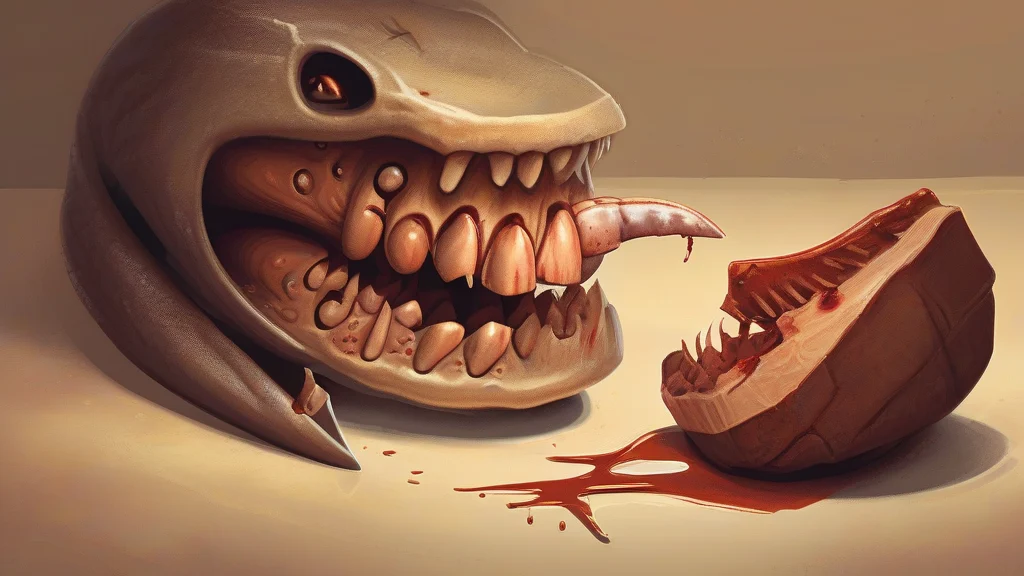
What does bite mean?
Bite is a fundamental English verb and noun describing the act of cutting into, gripping, or piercing with the teeth — or, by extension, the sting of an insect, the wound such an act leaves, or the portion of food taken between the teeth. Its figurative reach is wide: we 'bite our tongue' to stay silent, 'bite the bullet' to face hardship, and say a remark has 'real bite' when it carries sharp force. The word appears constantly in everyday speech, from grabbing a quick 'bite to eat' to warning that a dog may bite. It also pairs memorably with computing vocabulary through its homophone 'byte'. Versatile, vivid, and deeply embedded in idiom, bite remains one of the most useful words for describing both physical action and metaphorical sharpness.
To cut into, grip, or wound something with the teeth.
"He was careful not to bite his nails during the exam."
An act of biting; a wound made by teeth or a stinger; or a piece of food bitten off.
"The doctor examined the bite on her forearm."
Used for multiple instances of biting or multiple pieces of food bitten off.
"The mosquito bites kept him awake all night."
Bite and byte sound identical, yet one lives in your mouth and the other in your computer — a perfect homophone born of two very different worlds.
Reviewed by Deb Chak, Editor. AI-assisted content curated by RJS Tech Solutions LLP.
Etymology of bite
Bite comes from Old English bītan, meaning to pierce or cut with the teeth, which itself descends from Proto-Germanic *bītaną. Cognates include German beißen and Dutch bijten, all sharing the same ancestral root. The word has carried its core sense of tooth-driven cutting continuously since Old English, with figurative uses developing naturally over centuries.
Related word forms
How bite is actually used
Common in both formal and informal registers. Figuratively used to mean 'to accept an unpleasant situation' (as in 'bite the bullet') or 'to be convincing' ('the story really bites').
Easily confused with bite
A byte is a unit of digital information in computing, while bite is the act of cutting with teeth — they are homophones.
A bit is the past tense of bite or a small piece of something, whereas bite refers to the action of using teeth or the resulting wound.